20 Gemstones With Extraordinary Visual Characteristics
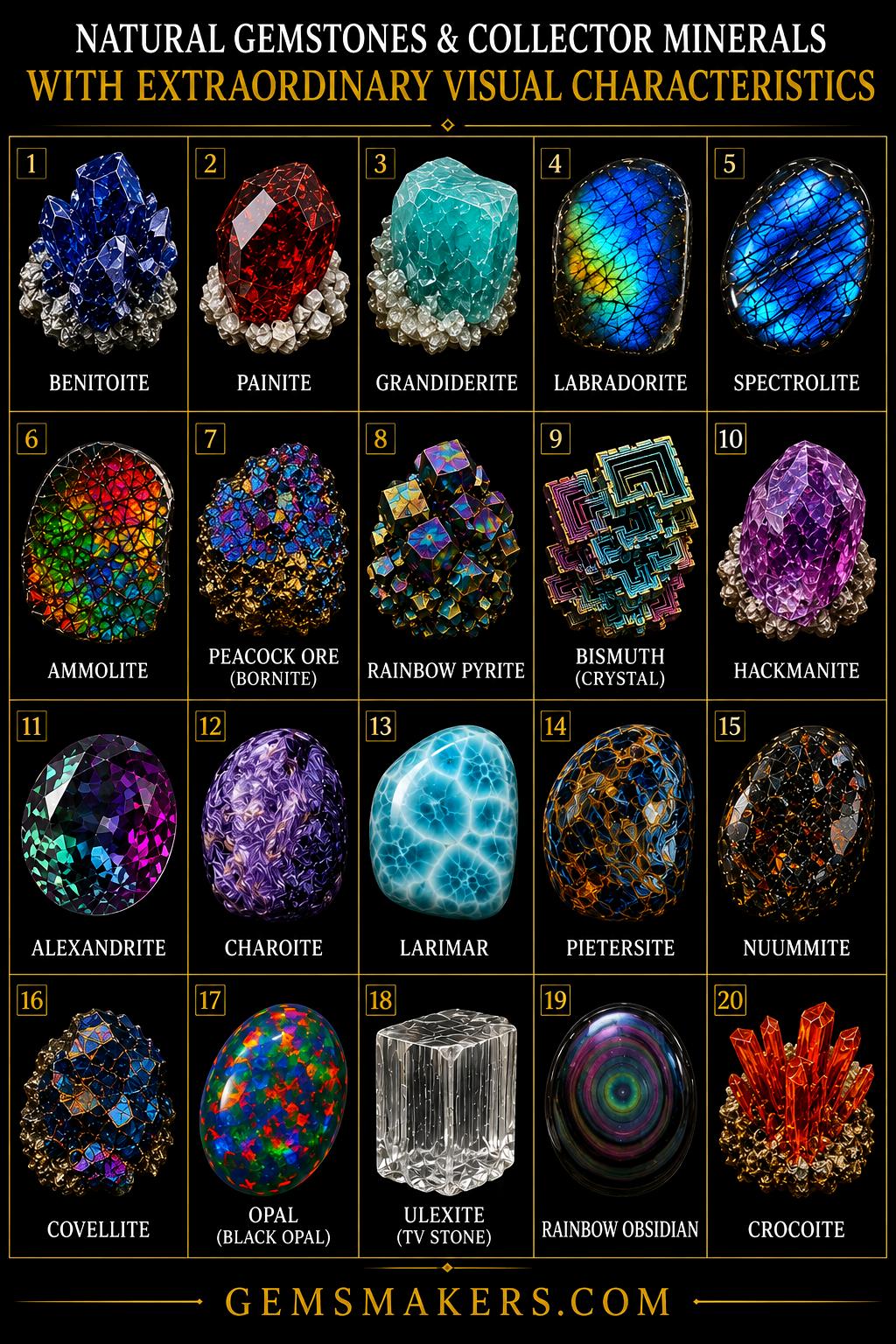
Some gemstones do more than look pretty. They flash color, glow under the right light, show rainbow patterns, move with a narrow band of light, or appear to change completely when turned in the hand. These are the stones that make people stop and stare. They do not feel ordinary, and they are not supposed to. Their beauty comes from the way light interacts with the stone, the way the crystal grew, and the unusual chemistry inside the material.
The gemstones and collector minerals in this image are some of the most visually exciting natural materials in the world. Benitoite, painite, grandidierite, labradorite, spectrolite, ammolite, bornite, rainbow pyrite, bismuth crystal, hackmanite, alexandrite, charoite, larimar, pietersite, nuummite, covellite, black opal, ulexite, rainbow obsidian, and crocoite all stand out for different reasons. Some are famous for color change. Some are known for iridescence. Some are prized for unusual crystal form. Some are collector minerals rather than traditional jewelry stones. All of them have one thing in common: they look unforgettable.
This kind of gemstone is especially interesting because it often shows a visual effect that is not easy to copy. A bright blue flash, a moving star, a rainbow sheen, or a color shift in different light feels almost unreal. But these are natural effects. They happen because of structure, layers, inclusions, or crystal chemistry. That is what makes these stones so fascinating to collectors and gem lovers.
Quick Answer
Gemstones with extraordinary visual characteristics are natural stones or collector minerals that stand out because of unusual optical effects, color changes, rainbow flashes, strong iridescence, or rare crystal patterns. The most famous examples in this image include alexandrite, labradorite, spectrolite, ammolite, black opal, charoite, larimar, pietersite, hackmanite, ulexite, rainbow obsidian, and crocoite. Some of the stones are rare jewelry gems, while others are better known as collector minerals or display specimens.
Why these stones look so different from ordinary gems
Most gemstones are admired for color, clarity, or brilliance. These stones are different because their visual appeal comes from something more unusual. Some appear to change color depending on the light. Some reflect rainbow flashes from internal layers. Some show a moving band of light across the surface. Some reveal hidden patterns that seem to come alive when the stone is rotated.
The reason for this is geological. A gemstone is not only a color in a polished shape. It is a natural material with a crystal structure, internal layers, and chemical properties. Those features can bend, reflect, split, or scatter light in interesting ways. The result is an optical effect that feels special and often very rare.
Collectors love stones like this because every piece can look different. A stone may be dark in one position and brilliant in another. A rough crystal may already be attractive before cutting. A cabochon can reveal a hidden glow. These are the stones that reward close looking.
Benitoite: rare blue brilliance with a glowing personality
Benitoite is one of the most admired collector gems in the world because of its vivid blue color and strong fluorescence. In normal light, fine benitoite shows a rich blue tone that looks clean and bright. Under ultraviolet light, some stones glow even more dramatically. That is one of the reasons collectors value it so highly.
The stone is rare, and that rarity adds to its appeal. But even without rarity, the visual effect would still be impressive. Benitoite has a crisp, almost electric appearance that makes it stand out from many other blue stones. Its sparkle and color make it feel modern and elegant at the same time.
Benitoite is a great example of a gemstone that looks extraordinary because of both chemistry and rarity. It is not common in everyday jewelry, which makes it even more desirable to serious collectors.
Painite: a gemstone famous for being incredibly rare
Painite is one of the best-known rare gemstones on Earth. For many years, it was considered one of the rarest minerals known. That alone made it famous. But the stone in this image also shows why collectors love it visually. Its deep red to brownish-red appearance can be rich, warm, and highly attractive.
Painite is not usually a gemstone that people see often in the market. That scarcity has built its reputation. It is one of those stones that attracts attention from people who enjoy unusual minerals and rare collector pieces. Even if someone has never seen one in person, they may already know the name because of its reputation.
A stone like painite proves that a gemstone does not need to flash rainbow colors to be extraordinary. Sometimes rarity itself becomes part of the visual appeal, especially when the color is this deep and intense.
Grandidierite: bluish-green beauty with a rare presence
Grandidierite is one of the rarest and most visually appealing collector gemstones in the world. Fine gem-quality material is hard to find, and that makes the stone even more exciting. Its color can range from bluish-green to greenish-blue, often with a cool, elegant look that feels calm and refined.
What makes grandidierite especially striking is that it does not look like a common gemstone. Its color is unusual enough to stand out, but the real appeal comes from the combination of rarity and beauty. The stone has a quiet but powerful presence. It feels sophisticated rather than loud.
Collectors love grandidierite because it is the kind of stone that feels special the moment it is seen. It is one of those rare minerals that can be admired both for its color and for the fact that very little fine material exists.
Labradorite: the stone with hidden flashes of blue and green
Labradorite is famous for labradorescence, which is the flash of color that appears from inside the stone when light hits it from the right angle. A dull-looking gray or dark stone can suddenly reveal brilliant blue, green, gold, or even purple flashes. That surprise is part of the magic.
The effect is caused by internal layers that reflect and interfere with light. This makes labradorite one of the most recognizable optical stones in the gem world. It feels almost alive because the flash moves as the stone moves.
Collectors and jewelry buyers both love labradorite because it gives so much visual interest. Even a single polished stone can show multiple flashes and colors. It is a stone that never looks exactly the same twice, and that makes it especially enjoyable to wear or display.
Spectrolite: the high-color variety of labradorite
Spectrolite is a variety of labradorite that is famous for stronger and more colorful flashes. It is often associated with darker body color and more intense spectral reflections. That makes it a favorite among people who want an even more dramatic version of labradorite.
The stone can show deep blue, green, gold, and sometimes purple or orange flash. The contrast between the dark background and the bright colors gives spectrolite a rich, almost cinematic look. It feels bold and polished.
Spectrolite is one of the best examples of how a gemstone family can produce different levels of visual intensity. Even though it belongs to the labradorite world, it has its own identity because the flash can be so vivid. That is why collectors often rank it among the most beautiful feldspar gemstones.
Ammolite: the rainbow from ancient shell material
Ammolite is one of the most visually unusual gemstone materials in the image. It is made from fossilized ammonite shell material, and its surface can show intense rainbow flashes. These colors are produced by the layered structure of the shell, which interacts with light in a very colorful way.
Ammolite can show red, green, blue, orange, and gold all in one piece. Some stones look like a tiny moving rainbow trapped inside fossil material. That is what makes it so unforgettable. It is both ancient and vibrant at the same time.
Collectors love ammolite because it is rare and visually dramatic. Jewelry buyers like it because no two pieces are exactly alike. It is one of those materials that feels almost too colorful to be natural, yet it absolutely is.
Peacock ore (bornite): natural color with metallic rainbow tarnish
Peacock ore is a trade name often used for bornite or similar copper minerals that show vivid rainbow tarnish. The surface can look blue, purple, green, gold, or red depending on the angle of light. That makes it one of the most colorful metallic minerals in the collector world.
Its appeal is immediate. The stone or specimen looks bright, unusual, and full of motion. It combines metallic shine with rainbow color, which creates a visual effect that feels bold and slightly wild. That is why it is so popular with mineral collectors.
Bornite is especially interesting because the rainbow effect is often caused by surface tarnish rather than the body color alone. That means the visual appearance can be intense and irregular, which only adds to its charm.
Rainbow pyrite: glittering geometry with colorful surface effects
Rainbow pyrite is one of those collector names that immediately catches attention. It refers to pyrite specimens that show colorful surface effects, often due to thin films, tarnish, or special surface conditions. The result can look like metallic stone covered in bright blue, purple, red, or gold flashes.
Pyrite is already famous for its cube-like crystal forms and golden shine, so the rainbow version feels even more unusual. It has both structure and color in one specimen. That makes it especially attractive to people who enjoy mineral specimens that feel bold and geometric.
Collectors appreciate rainbow pyrite because it turns a familiar mineral into something much more dramatic. It is a great example of how a common mineral can become visually extraordinary through surface effects.
Bismuth crystal: geometric steps and rainbow oxidation
Bismuth crystal is one of the most striking collector crystals in the image. It is important to note that bismuth crystals are usually grown rather than mined, but they are still highly admired as collector pieces because of their spectacular shape and color. Their stepped, staircase-like geometry looks almost artificial, and the surface often shows rainbow oxidation colors.
That combination makes bismuth crystal unforgettable. It has sharp edges, colorful reflections, and a futuristic appearance that stands out immediately. It does not look like an ordinary mineral specimen. It looks almost engineered, even though it forms through natural crystal growth under controlled conditions.
Collectors like bismuth because it is one of the most visually unique crystals available. Its shape alone is remarkable, and the rainbow surface adds even more character.
Hackmanite: the stone that can change after light exposure
Hackmanite is one of the most unusual gemstones in the image because it can show tenebrescence. That means its color can change after exposure to light, especially ultraviolet light, and then gradually return or change again over time. This makes it a fascinating stone for collectors who enjoy interactive optical behavior.
Its lilac to purple color can already be attractive, but the way it responds to light is what really makes it special. Some hackmanite specimens also fluoresce under UV light. That combination of color and light response makes it one of the most interesting stones in the rare mineral world.
Hackmanite is not a common jewelry gemstone, but it is a very exciting collector mineral. It feels alive in a way because it changes with the environment around it.
Alexandrite: the famous color-change gemstone
Alexandrite remains one of the most famous gemstones in the world because of its dramatic color change. In daylight, it can appear green or bluish green. In incandescent light, it can turn red or purplish red. This change happens because of the stone’s crystal chemistry and the way it absorbs light.
The reason alexandrite is so admired is that the change can be very strong. It does not just shift a little. In the best stones, it seems to become a different gem altogether. That makes it one of the most magical-looking natural gemstones ever discovered.
Collectors prize alexandrite because it combines rarity, beauty, and optical surprise. Jewelry buyers love it because it has a refined look under any light and a dramatic personality when the lighting changes. It is one of the clearest examples of nature’s visual tricks.
Charoite: swirling purple patterns unlike anything else
Charoite is famous for its swirling purple texture. It does not rely on sparkle or transparency in the same way many other gemstones do. Instead, it has a flowing, fibrous, almost painterly appearance. That makes it one of the most visually distinctive stones in the collector world.
The stone often looks like moving ribbons, clouds, or brushstrokes in purple, lavender, white, and black. That gives it a very organic and artistic feel. It is not a gemstone that tries to imitate a faceted jewel. It is valued for its bold pattern and unusual look.
Collectors love charoite because it is immediately recognizable and deeply different from ordinary purple stones. It feels rich, mysterious, and highly decorative. It is one of the stones in this image that proves pattern alone can be enough to create beauty.
Larimar: soft blue with cloud-like character
Larimar is one of the most beloved stones in the image because of its soft blue color and cloudy white patterns. It has a calm, tropical look that feels fresh and soothing. Some pieces show stronger color, while others have more diffuse and creamy patterns. Either way, the stone has a very recognizable identity.
Larimar is especially attractive because it does not look like most blue gemstones. It is softer, more painterly, and more natural in appearance. The patterns often resemble sea foam, sky, or water, which makes the stone feel peaceful and unique.
Collectors enjoy larimar because it has a strong visual identity connected to place and color. Jewelry buyers like it because it creates an easy, relaxed style. It is one of the stones that feels gentle but memorable.
Pietersite: stormy, twisted, and full of movement
Pietersite is often called the “tempest stone” because of its storm-like appearance. It shows mixed colors, swirling patterns, and a chatoyant effect that can look like moving light trapped in a storm cloud. That gives it a dramatic and energetic appearance.
The stone in the image looks dark, layered, and full of internal movement. Pietersite is one of the best examples of a gemstone that looks active even when still. Its colors and fibers create a sense of motion and turbulence that many collectors find exciting.
Pietersite is not a standard jewelry stone for everyone, but it is highly attractive to people who enjoy dramatic patterns and strong character. It feels wild, bold, and natural all at once.
Nuummite: dark stone with subtle flashes and deep texture
Nuummite is one of the oldest minerals in this image and one of the most visually mysterious. It often appears dark, but under the right light it can reveal flashes of gold, blue, or bronze. That hidden shimmer is part of its appeal. The stone has a deep, ancient feel that makes it highly collectible.
Nuummite is admired because it does not give away all its beauty at once. It often looks dark and serious until the light changes. Then subtle flashes appear, and the stone becomes much more interesting. That makes it one of the stones that rewards close inspection.
Collectors appreciate nuummite because it feels ancient, rare, and powerful. It is a stone with quiet intensity rather than loud brightness.
Covellite: dark metallic blue with strong surface color
Covellite is one of the most striking minerals in the image because of its dark metallic blue and iridescent appearance. Depending on the surface and lighting, it can show deep blue, purple, indigo, or bronze tones. This makes it feel unusual and highly dramatic.
Covellite is especially appealing because its colors are not common in metallic minerals. That rich blue-black look gives it a very strong identity. Collectors love it because it looks both dark and colorful at the same time.
The visual effect is one of the reasons covellite stands out so much in mineral collections. It is not a gemstone in the everyday sense, but it absolutely belongs in a collector mineral display.
Black opal: the king of play-of-color
Black opal is one of the most famous optical gemstones in the world. Its dark body color makes the flashes of rainbow color appear even stronger. Reds, greens, blues, oranges, and golds can all sparkle across the surface depending on how the stone is turned.
The reason black opal is so beloved is that the contrast is so powerful. The dark background gives the color flashes a stage to shine on. That makes the stone feel alive, intense, and almost theatrical.
Collectors and jewelry buyers value black opal because no two stones are the same. The pattern, color play, and brightness all vary. It is one of the finest examples of natural optical beauty in a gemstone.
Ulexite: the famous “TV stone”
Ulexite is known as the “TV stone” because it can transmit an image from one side to the other along its fibrous structure. This unusual property makes it one of the most fascinating optical minerals in the image. It can look white, silky, or translucent, but its real magic is in the way it moves images.
This makes ulexite extremely interesting from a scientific point of view. It is not just pretty. It behaves in a way that surprises people. That kind of optical effect is exactly what makes collector minerals so exciting.
Ulexite is usually not used as a common jewelry stone, but it is a very memorable specimen. Its optical behavior makes it stand out in any mineral collection.
Rainbow obsidian: hidden rainbow sheen inside volcanic glass
Rainbow obsidian is one of the most striking volcanic glasses in the collector world. At first, it may look dark and simple. But when the light hits it at the right angle, it can reveal bands of purple, green, gold, and blue. The effect comes from internal layers and microscopic structure within the glass.
That hidden rainbow makes the stone feel mysterious and beautiful. It is one of those materials that changes a lot with movement. The colors are not always visible at once, which adds to the stone’s charm.
Collectors enjoy rainbow obsidian because it combines a dark base with unexpected light effects. It feels elegant, moody, and visually deep.
Crocoite: vivid orange crystals with high visual energy
Crocoite is one of the most eye-catching minerals in the image because of its vivid orange crystals. The bright color and sharp crystal form create a very strong visual effect. It is not a subtle mineral. It is bold and unmistakable.
Collectors love crocoite because it often forms thin, elongated crystals with a bright, almost glowing orange-red tone. It stands out immediately in a mineral cabinet. That kind of strong color gives it serious display value.
Crocoite is one of those minerals that proves a collector stone does not need to be transparent or faceted to be exciting. A strong crystal form and intense color are often enough.
Why collectors and jewelry lovers care about these stones
These stones are important because they show the broader range of gemstone beauty. Not every stone needs to be a classic faceted jewel. Some are admired for optical change. Some for surface color. Some for unusual crystal form. Some for being rare in collector circles. Some are famous because of the way they were first discovered or how little material exists.
Jewelry lovers care about them because they create designs that feel different from ordinary gemstone jewelry. Collectors care about them because they represent special geological processes and unusual natural beauty. Both groups are drawn to the same thing: surprise. These stones surprise the eye.
Final thoughts
Natural gemstones and collector minerals with extraordinary visual characteristics are some of the most exciting stones in the world. Benitoite, painite, grandidierite, labradorite, spectrolite, ammolite, peacock ore, rainbow pyrite, bismuth crystal, hackmanite, alexandrite, charoite, larimar, pietersite, nuummite, covellite, black opal, ulexite, rainbow obsidian, and crocoite all show how creative nature can be.
Some of these stones shift with light. Some flash rainbow colors. Some glow under UV. Some show unusual crystal growth or layered patterning. Some are true gemstone rarities, while others are collector minerals that are treasured for display. All of them prove the same point: nature can create visual effects that feel almost impossible, but they are completely real.
For anyone who loves gemstones, these are the kinds of stones that make collecting and studying gems so rewarding. They are not just beautiful. They are unforgettable.
Looking for natural loose gemstones, collector stones, and jewelry-grade gems?
← Back