Colombian Gemstones: Emeralds, Tourmalines, Quartz, and the Rich Mineral Beauty of Colombia
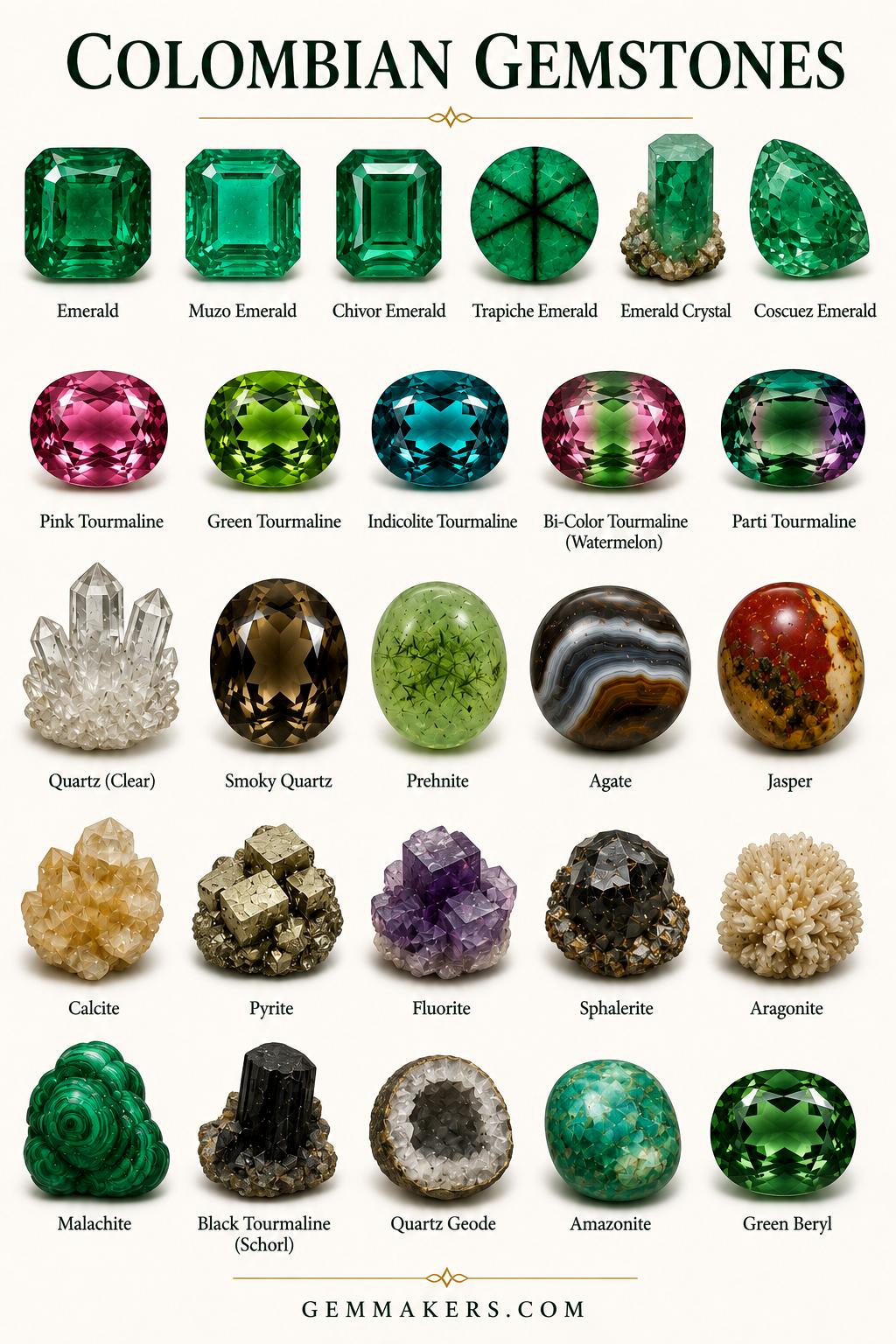
Colombian gemstones are some of the most admired natural stones in the world because they combine strong color, beautiful crystal form, and a deep reputation for quality. When people think of Colombian gemstones, emerald is usually the first stone that comes to mind, and for good reason. Colombia has long been known as one of the most important sources of fine emeralds, especially stones with rich green color and elegant transparency. The image shows that beautifully with emerald, Muzo emerald, Chivor emerald, trapiche emerald, emerald crystal, and Coscuez emerald all displayed in one place. Each of these names tells a different part of Colombia’s gemstone story. Some are famous for their mine locality, some for their crystal pattern, and some for the natural beauty of the rough or faceted stone itself. Together, they show why Colombian emeralds are so important in the gemstone world.
What makes Colombian emeralds special is not only their color but also their character. The green often feels alive, fresh, and deeply luxurious, which is exactly why emerald has stayed so popular in fine jewelry and collector circles for centuries. Muzo emerald is especially respected because it represents one of the most legendary emerald sources on Earth. Chivor emerald is another classic name that carries prestige and history. Trapiche emerald is one of the most fascinating gemstone forms because of its natural six-ray star-like pattern, which makes it instantly recognizable and highly collectible. Emerald crystal specimens show the mineral in its raw and natural state, while Coscuez emerald adds another important Colombian source to the picture. This variety proves that Colombian gemstones are not limited to one style. They can be rough, crystal, faceted, patterned, or museum-worthy, and they still carry the same powerful identity.
The image also highlights Colombian tourmalines, including pink tourmaline, green tourmaline, indicolite tourmaline, bi-color tourmaline, and parti tourmaline. These stones add a different side to Colombia’s gemstone wealth. Tourmaline is one of the most colorful gemstone families in existence, and the Colombian examples shown here are especially attractive because they offer strong color contrast and pleasing transparency. Pink tourmaline gives a soft romantic tone. Green tourmaline feels fresh and vibrant. Indicolite tourmaline adds a deep blue-green richness. Bi-color tourmaline and parti tourmaline are especially appealing to collectors because they show multiple colors in one crystal, which makes them feel natural, artistic, and rare. These tourmalines help expand the idea of Colombian gemstones beyond emerald and show that Colombia has a much broader mineral identity than many people realize.
Another striking part of the image is the selection of quartz and quartz-related minerals. Clear quartz is one of the most versatile and widely recognized minerals in the world, but in a Colombian gemstone collection it feels especially important because it provides contrast and clarity alongside the richer colored stones. Smoky quartz brings a dark transparent warmth, while quartz geode adds a dramatic crystal cavity look that appeals to collectors. Colombian quartz is not just a background mineral here. It plays an important role by showing the range of natural forms that can appear in the country’s geology. Quartz is often a foundation stone in gemstone education because it is familiar, durable, and visually useful. In this image, it gives the whole collection balance.
The image also includes beautiful mineral specimens such as calcite, pyrite, fluorite, sphalerite, aragonite, and malachite. These are not always the first stones that come to mind when people hear “gemstones,” but they are important because they show the richness of Colombian mineral diversity. Calcite can appear in soft golden tones and attractive crystal groups. Pyrite gives metallic brilliance and cube-like structure, often earning the nickname “fool’s gold” even though it is a real and fascinating mineral in its own right. Fluorite is famous for its color variety and often dramatic crystal form, making it a favorite among collectors. Sphalerite is known for its strong sparkle and deep brown to honey tones. Aragonite can form in unique cluster shapes. Malachite brings vivid green banding and a strong organic look. These minerals help show that Colombian gemstones are not only about faceted jewelry stones. They also include natural mineral specimens with strong collector appeal.
Black tourmaline, also shown in the image as schorl, adds an important grounding tone to the collection. It gives contrast to the brighter emeralds and tourmalines and helps show the full mineral spectrum of Colombia. Black tourmaline is valued for its bold appearance, protective symbolism, and polished or crystal form. Amazonite adds another beautiful color to the group with its soft blue-green shade, while green beryl rounds out the collection with a classic gemstone family link to emerald. Green beryl is especially useful because it reminds viewers that emerald itself belongs to the beryl family, and that Colombia’s geology produces multiple important members of that family. This kind of variety makes Colombian gemstone collections feel complete and highly educational.
One of the most attractive things about Colombian gemstones is the way they combine luxury and geology. Emeralds often carry royal prestige, but the image shows that Colombia also produces minerals with strong crystal character, collector value, and natural patterning. This makes the country one of the most interesting places in the gemstone world. A collector can admire the emeralds for their famous green color, then move to tourmaline for color contrast, then look at quartz and geode specimens for structure, then admire pyrite, fluorite, or malachite for mineral diversity. The whole collection feels rich, layered, and naturally powerful. That is what makes Colombian gemstones so easy to love.
For jewelry buyers, Colombian gemstones are especially appealing because they offer both prestige and personality. An emerald ring feels classic and luxurious. A tourmaline pendant can feel colorful and modern. A quartz or geode piece can feel organic and artistic. A pyrite specimen can feel metallic and bold. A malachite cabochon can feel lush and dramatic. Colombian gemstones work in many different design styles because their beauty is not one-dimensional. They can be elegant, rustic, collector-oriented, or fashion-forward depending on how they are cut and set. That versatility makes them useful for both jewelers and gemstone enthusiasts.
For gemstone businesses, Colombia is a powerful keyword and a powerful story. Buyers often search for Colombian emeralds, Muzo emerald, Chivor emerald, trapiche emerald, Colombian tourmaline, Colombian quartz, and Colombian mineral specimens because they want quality, origin, and trust. Origin matters in gemstones because it helps people understand where the stone came from and why it looks the way it does. Colombian emeralds in particular have a reputation that makes them stand out in the market. Adding the other minerals shown in this image broadens that story and makes the content more useful for search, education, and product presentation.
Colombian gemstones are ultimately about more than one famous stone. They are about a mineral landscape that produces rich green emeralds, colorful tourmalines, clear quartz, dramatic geodes, sparkling pyrite, vivid fluorite, patterned malachite, and many other natural treasures. They remind us that one country can hold a whole world of gemstone beauty. From the deep green of emerald to the bright contrast of bi-color tourmaline and the earthy strength of quartz and mineral clusters, Colombia offers a gemstone identity that is both classic and diverse. That is why Colombian gemstones continue to attract collectors, jewelry lovers, and anyone who appreciates the beauty of natural stone.
Looking for natural Colombian emeralds, tourmalines, quartz, and collector gemstones?
← Back