Gemstones Through the Jewelry Ages: From Victorian Romance to Modern Luxury
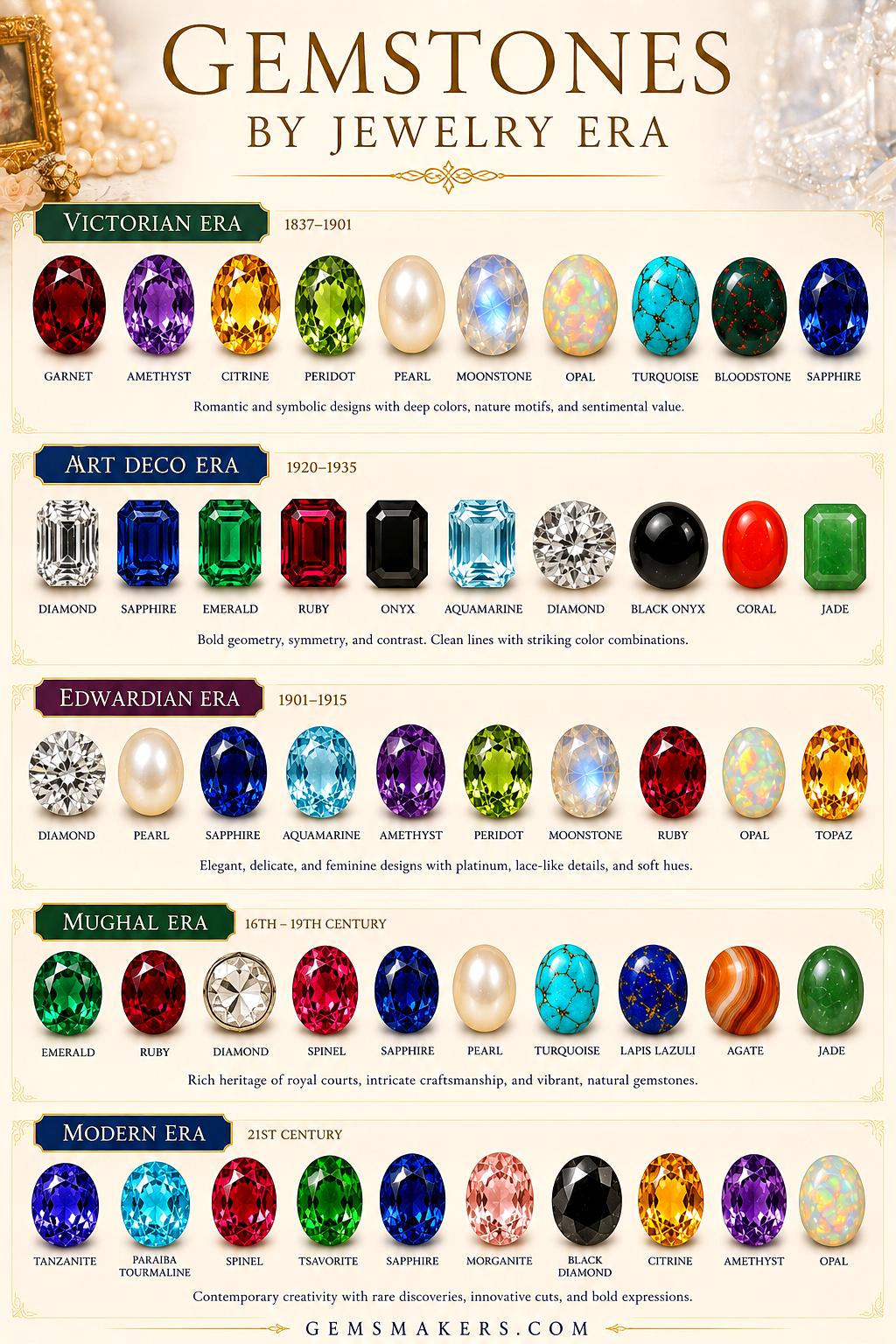
Gemstones have always carried more than color. They carry the style of the era that loved them, the craft of the goldsmith who shaped them, and the taste of the people who wore them. That is why gemstones by jewelry era is such a strong subject for anyone interested in natural stones, antique jewelry, and the history of design. Each period in jewelry history chose different stones, different cuts, and different moods. Some eras loved deep romantic colors. Some favored bright symmetry and bold contrast. Some preferred delicate elegance, while others celebrated rich heritage and royal craftsmanship. The image shows this beautifully through the Victorian Era, Art Deco Era, Edwardian Era, Mughal Era, and Modern Era. Each one tells a different story, not only about fashion but about how gemstones themselves were understood and valued.
The Victorian Era, from 1837 to 1901, was a time when jewelry often carried emotional meaning. The stones chosen in this period were frequently rich in color, symbolic in tone, and suited to sentimental designs. Garnet, amethyst, citrine, peridot, pearl, moonstone, opal, turquoise, bloodstone, and sapphire all fit naturally into the Victorian mood. These stones were often used in brooches, lockets, rings, pendants, and ornate pieces that felt personal and expressive. Garnet brought deep red warmth and a sense of romance. Amethyst added purple dignity and softness. Citrine gave the era a golden glow. Peridot brought fresh green life to a period that often looked to nature for inspiration. Pearl was treasured for its soft beauty and association with grace. Moonstone and opal added mysterious light effects that suited the romantic imagination of the time. Turquoise, bloodstone, and sapphire gave variety, contrast, and elegance. Victorian jewelry often felt sentimental, and the stones were chosen to match that feeling. A piece from this era was not only decorative. It was emotional, symbolic, and deeply connected to the personal story of the wearer.
The Art Deco Era, from 1920 to 1935, moved in a completely different direction. This period loved geometry, symmetry, contrast, and strong visual lines. Jewelry became more streamlined, more architectural, and more daring in its use of color. The stones shown in the image for this era include diamond, sapphire, emerald, ruby, onyx, aquamarine, black onyx, coral, and jade. These gemstones fit the bold and structured aesthetic of Art Deco perfectly. Diamonds reflected the clean angular brilliance of the age. Sapphire, emerald, and ruby brought intense primary color into sharp, elegant settings. Onyx and black onyx created dramatic contrast and a sense of modern luxury. Aquamarine added crisp blue clarity. Coral and jade gave the era a refined but adventurous touch, especially in combinations with white metal and geometric mounting. Art Deco jewelry often looked sleek and confident, and the gemstone choices supported that look. Unlike the softer and more sentimental Victorian mood, Art Deco was about refinement through structure. It loved strong forms, exact edges, and a visual language that felt both glamorous and modern.
Edwardian jewelry, from 1901 to 1915, sits between the ornate softness of the Victorian world and the bold geometry of Art Deco. It is one of the most delicate and elegant periods in jewelry history. The stones shown in the image for this era include diamond, pearl, sapphire, aquamarine, amethyst, peridot, moonstone, ruby, opal, and topaz. These stones suited the Edwardian taste for lightness, femininity, and refined beauty. Diamond and pearl were especially important because they echoed the lace-like, airy settings that defined the era. Sapphire and aquamarine added cool color without overwhelming the delicate metalwork. Amethyst and peridot gave a gentle touch of color, while moonstone and opal contributed soft glowing effects. Ruby and topaz added warmth and brightness, but always in a way that supported elegance rather than heaviness. Edwardian jewelry often looked almost ethereal, with intricate platinum work creating a lace effect around the stones. The gemstones chosen for this era were therefore not only beautiful on their own but perfectly matched to the airy quality of the designs. The result was jewelry that felt graceful, romantic, and lightly regal.
The Mughal Era, from the 16th to the 19th century, stands apart because it represents a world of royal courts, elaborate craftsmanship, and a love of rich, saturated gemstones. In the image, the Mughal selection includes emerald, ruby, diamond, spinel, sapphire, pearl, turquoise, lapis lazuli, agate, and jade. This combination reflects a strong taste for vivid color and luxurious ornament. Mughal jewelry was often highly decorative, filled with intricate settings, carved stone, and strong visual richness. Emeralds brought lush green depth. Rubies and spinels added brilliant red royal energy. Diamonds gave sparkle and authority. Sapphire contributed a deep formal blue. Pearl added refinement and softness, while turquoise and lapis lazuli brought vibrant color and strong historical character. Agate and jade connected the jewelry to carved and polished traditions that suited the artistry of the period. Mughal gemstone style was not minimal. It was majestic. It celebrated abundance, craftsmanship, and the visible wealth of the court. The gems were not hidden. They were displayed with purpose and confidence.
The Modern Era, shown as the 21st century, reflects a different kind of gemstone taste. Modern jewelry often values rarity, innovation, bold color, and visual impact. The image shows tanzanite, Paraíba tourmaline, spinel, tsavorite, sapphire, morganite, black diamond, citrine, amethyst, and opal as modern favorites. These stones represent the present-day fascination with both rare discoveries and fresh design language. Tanzanite has become one of the most recognizable modern luxury gemstones because of its vivid blue-violet color. Paraíba tourmaline stands out for its neon-like glow and electric brightness. Spinel has gained much more attention in modern markets because buyers now appreciate its quality and wide range of colors. Tsavorite offers a vibrant green that feels sharp and contemporary. Sapphire remains timeless, but in modern jewelry it is often used in more creative cuts and settings. Morganite fits the modern taste for soft blush tones and romantic pastel luxury. Black diamond brings edge and boldness. Citrine and amethyst remain popular because they are accessible, colorful, and adaptable. Opal continues to fascinate because of its play-of-color and its ability to look different from every angle. The modern era is less about one fixed aesthetic and more about personal expression, rarity, and design freedom.
What makes gemstones by jewelry era especially valuable is that it helps show how style changes over time without changing the fundamental attraction of the stone itself. A garnet can feel Victorian in a sentimental brooch, but it can also feel modern in a clean ring. A diamond can appear Edwardian in a delicate pendant, Art Deco in a geometric bracelet, Mughal in a royal setting, or modern in a minimalist design. The era changes the context, but the gemstone remains a powerful object of beauty. That is why jewelry history is so useful for gemstone lovers. It helps explain why some stones were loved in specific periods and why they continue to return in new forms today. A gemstone is never just a mineral. It is also a design choice, a cultural symbol, and a material that reflects the taste of its time.
The Victorian Era often favored stones with emotional or symbolic associations. Garnet could suggest deep feeling. Amethyst could suggest dignity and refinement. Citrine brought warmth and optimism. Peridot gave a fresh green that connected with nature. Pearl represented purity and grace. Moonstone and opal added mystery and shifting light. Turquoise brought color with a softer, more intimate feeling. Bloodstone gave a darker, more dramatic note. Sapphire added formality and prestige. These choices worked together to create jewelry that often felt personal, almost like wearable memory. Victorians loved pieces that carried meaning, and gemstones were perfect for that because color and tradition could communicate emotion without words.
Art Deco, by contrast, made gemstones part of a more modern visual language. Strong shapes and striking contrast were central to the style. Diamond and sapphire were natural fits because they could be arranged in high-impact geometric settings. Emerald and ruby added bold blocks of color. Onyx and black onyx gave the era its famous black-and-white graphic look. Aquamarine brought a bright clean blue, while coral and jade added a touch of elegance and exotic flair. Art Deco pieces often looked like architecture in miniature. The stones helped define the building blocks of the design. They were not only decorative but structural in the way they contributed to the overall form. That is one reason Art Deco jewelry is still so admired. It looks crisp, deliberate, and unmistakably stylish.
Edwardian jewelry, on the other hand, leaned toward softness, shimmer, and grace. Diamonds and pearls were absolutely central because they matched the airy platinum work that defined the period. Sapphire, aquamarine, moonstone, opal, amethyst, peridot, ruby, and topaz added gentle color while preserving the delicate feeling. This period prized elegance over heaviness. The stones were often arranged in balanced, refined patterns that looked almost like embroidery made from metal and gems. The jewelry felt feminine, light, and graceful. It is no surprise that collectors still love Edwardian pieces because the combination of delicate setting and elegant gemstones creates an effect that is very difficult to imitate.
The Mughal Era was more about richness, royalty, and craftsmanship. Its gemstone choices show a love for full color and luxurious expression. Emerald, ruby, diamond, spinel, sapphire, pearl, turquoise, lapis lazuli, agate, and jade all contribute to a visual world that feels royal, ornate, and powerful. Mughal jewelry often integrated gem carving, inlay, and highly skilled setting work. The stones were not merely worn. They were presented as symbols of courtly power and artistic refinement. Emerald and ruby in particular suited the royal atmosphere because of their saturated tones. Lapis lazuli and turquoise brought bold blue-green color. Pearl and diamond balanced the richness with brightness. Jade and agate contributed a sense of carved beauty and material depth. This era reminds us that gemstone taste is shaped as much by court culture as by geology.
The Modern Era is different again because it often seeks out stones that feel both luxurious and individual. Tanzanite, Paraíba tourmaline, spinel, tsavorite, sapphire, morganite, black diamond, citrine, amethyst, and opal all reflect this modern appetite for distinctive gems. Modern jewelry is often less constrained by tradition and more open to rare color combinations, unconventional cuts, and expressive settings. That is why paraíba tourmaline and tanzanite are so important today. They feel fresh, rare, and immediately recognizable. Spinel has also risen sharply in modern popularity because collectors and designers now understand its true value. Tsavorite is admired for its intense green. Morganite offers a soft blush look that fits contemporary romance. Black diamond gives a sharp modern edge. The modern era is especially open to variety, which means gemstones are chosen not just for status but for individuality.
Studying gemstones by jewelry era also helps buyers and collectors understand how design trends affect gemstone popularity. A stone may rise in demand when a certain type of jewelry becomes fashionable. A stone may become classic because it fits many eras. A stone may become desirable again when antique styles return to fashion. This is one reason gemstone knowledge is useful in business. It helps explain why some stones remain timeless while others are more tied to a particular design movement. Garnet, pearl, sapphire, emerald, ruby, and diamond are all timeless in different ways, but each one also has strong historical moments. Opal, moonstone, and turquoise can feel antique, romantic, or bohemian depending on how they are set. Modern stones like tanzanite and paraíba tourmaline show how new discoveries can enter luxury jewelry quickly. Understanding these patterns makes gemstone selection more intelligent for both sellers and buyers.
Another important point is that jewelry era does not just describe old styles. It also shows how those styles continue to influence current design. Many modern jewelers still borrow from Victorian sentiment, Art Deco geometry, Edwardian delicacy, and Mughal richness. This means gemstones keep cycling through new interpretations. A garnet pendant may feel Victorian-inspired. A diamond and onyx ring may feel Art Deco. A pearl and sapphire necklace may feel Edwardian. A ruby, emerald, and turquoise composition may feel Mughal-inspired. A tanzanite or paraíba tourmaline design may feel purely contemporary. The gemstone itself becomes a bridge between past and present. That is part of the reason gemstone history is so useful for anyone building a jewelry brand or a gemstone collection.
The image also shows how specific stones seem to belong naturally to certain eras because of their color and visual mood. Garnet, amethyst, citrine, peridot, pearl, moonstone, opal, turquoise, bloodstone, and sapphire feel especially Victorian because they combine romance and symbolism. Diamond, sapphire, emerald, ruby, onyx, aquamarine, coral, and jade feel especially Art Deco because they work well in contrast-driven design. Diamond, pearl, sapphire, aquamarine, amethyst, peridot, moonstone, ruby, opal, and topaz feel elegant and airy in Edwardian settings. Emerald, ruby, diamond, spinel, sapphire, pearl, turquoise, lapis lazuli, agate, and jade feel grand and heritage-rich in Mughal design. Tanzanite, paraíba tourmaline, spinel, tsavorite, sapphire, morganite, black diamond, citrine, amethyst, and opal feel exciting, rare, and very current in modern jewelry. These visual associations are not rules, but they are useful patterns that help explain how gemstone taste has evolved.
For a gemstone business, content about jewelry era can be very effective because it is both educational and commercially attractive. People who love antique jewelry search for Victorian gemstones. People who love glamorous geometric designs search for Art Deco gemstones. People who admire elegant platinum work search for Edwardian jewelry stones. People interested in royalty or heritage search for Mughal gemstones. People who love contemporary luxury search for modern rare gems. This means one well-written article can serve many types of readers while still focusing on natural gems, value, design, and collectability. It gives context to the stone and helps the buyer understand where the style comes from. That is exactly the kind of content that builds trust and keeps readers engaged.
Gemstones by jewelry era also has a timeless appeal because it combines history, design, and natural beauty in one topic. You can talk about romantic stones, geometric stones, royal stones, and innovative stones all in the same framework. That makes the subject broad enough for serious collectors and simple enough for casual readers. A person might come looking for one gemstone and leave with a better understanding of how jewelry history shaped the market. That is powerful content for a gemstone brand because it turns a stone catalog into a story-driven experience. The more people understand the era, the more they appreciate the gemstones that belonged to it.
In the end, every era leaves behind a gemstone signature. Victorian jewelry leaves behind romance and symbolism. Art Deco leaves behind geometry and contrast. Edwardian leaves behind delicacy and refined elegance. Mughal jewelry leaves behind royal richness and craftsmanship. Modern jewelry leaves behind innovation, rarity, and personal style. The stones in each era help tell that story. They are not just decorative pieces. They are the visual language of history. That is why gemstones by jewelry era remains such a useful and beautiful subject for collectors, jewelers, and gemstone lovers alike.
Looking for natural loose gemstones, collector stones, and jewelry-grade gems?
← Back