How Gemstones Grow: The Crystal Systems That Shape Their Natural Forms
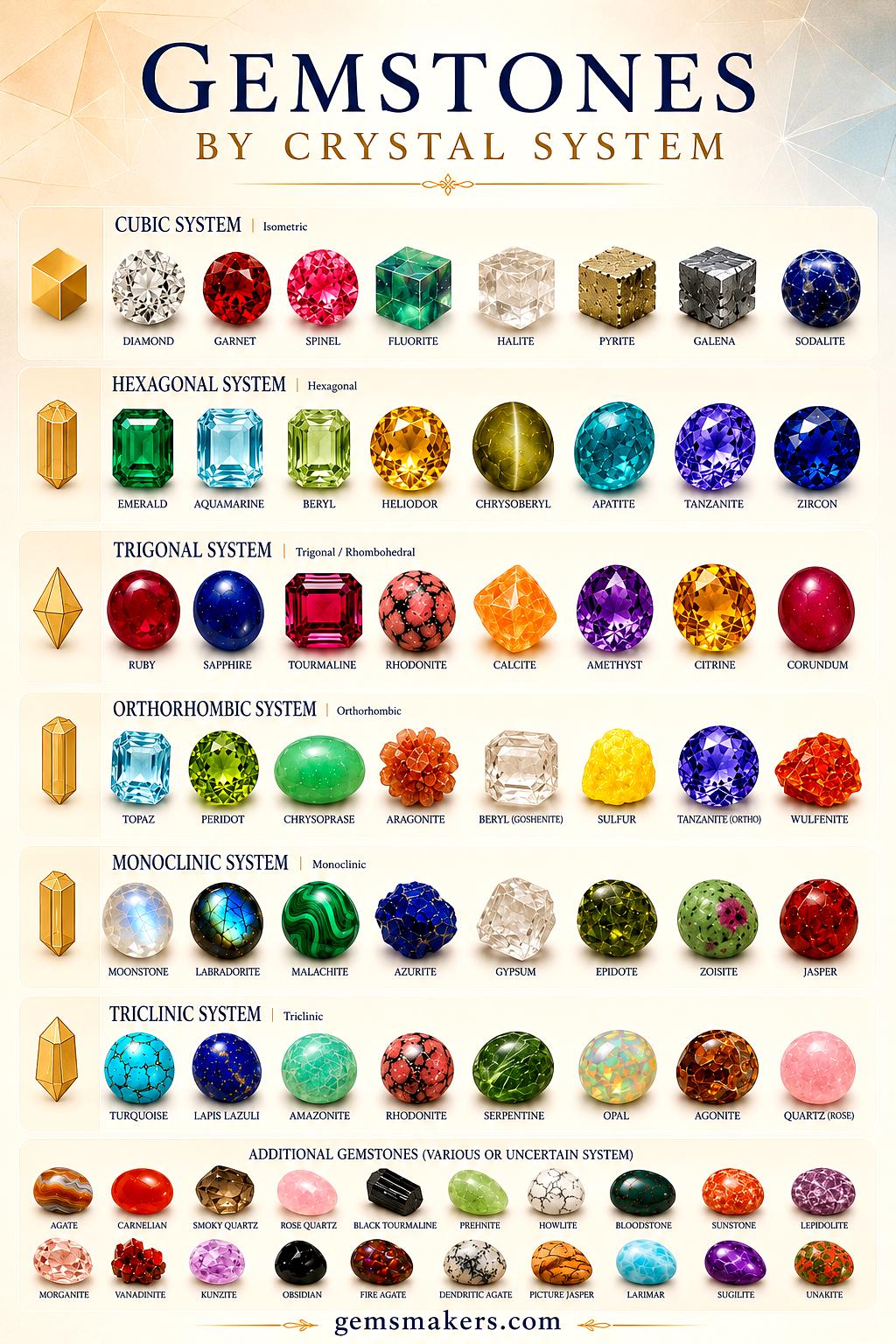
Gemstones by crystal system is one of the most important ways to understand why minerals look the way they do, how they grow in nature, and why some stones form cubes, some form long prisms, some look like flat plates, and others appear as rounded or irregular masses. When people search for crystal systems of gemstones, gemstone crystal structure, types of crystal systems, gemstone habit chart, or mineral crystal shape guide, they are usually trying to understand the hidden geometric pattern behind a stone’s natural form. Crystal system is not just a scientific label. It is the basic framework that controls how atoms arrange themselves inside a mineral and how that internal structure becomes visible on the outside as crystal shape. That is why crystal systems are one of the best starting points for learning gemology. Once you understand crystal systems, many gemstones become much easier to identify, appreciate, and compare. A gemstone that forms cubes does not happen by accident. A gemstone that grows as a six-sided prism is following a specific internal order. A stone that appears as a flat plate or a dense rounded mass is also expressing its own crystal logic. The Earth is full of hidden geometry, and crystal system is one of the clearest ways to see it.
The cubic system, also called the isometric system, is one of the most iconic and easy-to-recognize crystal systems in the gemstone world. Gemstones in the cubic system include diamond, garnet, spinel, fluorite, halite, pyrite, galena, and sodalite. These minerals often form blocky, symmetrical shapes that can look like cubes, octahedrons, or other strongly balanced forms. Diamond is one of the most famous examples because it can develop in sharp natural octahedral crystals that are instantly recognizable. Garnet often forms dodecahedral or trapezohedral shapes that reflect the symmetry of the cubic system even though the outside is not always a perfect cube. Spinel can form beautiful octahedral crystals that are highly admired by collectors. Fluorite is another favorite cubic mineral because it can form cubic crystals, octahedrons, and related forms in a wide range of colors. Halite, pyrite, and galena are especially interesting because they often show blocky forms with sharp faces and strong geometric appeal. These stones are loved not only for their chemistry and color but also for the powerful sense of order they bring to a collection.
Cubic crystal systems are important because they show maximum symmetry. Many stones in this system feel architectural and engineered, almost as if they were designed by a machine rather than grown by nature. That is part of their charm. A pyrite cube with metallic faces, a galena cube with mirror-like surfaces, or a fluorite crystal with perfect edges can look astonishingly artificial in the best possible way, even though they are completely natural. This makes cubic gemstones especially popular among mineral collectors who love geometry and symmetry. The same system also includes some of the most famous gemstones in the world, such as diamond and spinel, proving that the cubic system is not only scientifically important but also commercially and visually significant. A crystal system chart helps show this relationship clearly by grouping gemstones according to their geometric backbone rather than just their color or trade name.
The hexagonal system is another major gemstone crystal system, and it produces some of the most beloved gemstones in jewelry and specimen collecting. Hexagonal gemstones include emerald, aquamarine, beryl, heliodor, chrysoberyl in some crystal habits, apatite, tanzanite, and zircon as shown in the chart style the image presents. The most classic examples are beryl and quartz-related forms that naturally grow in six-sided patterns. Hexagonal symmetry often creates long prisms, clean terminations, and elegant elongation. Emerald and aquamarine are especially iconic because they belong to the beryl family, and beryl crystals often grow as beautiful six-sided prisms with strong clarity and graceful shape. Emerald is famous not only for its green color but also for its hexagonal crystal structure, which helps explain the way it grows in nature. Aquamarine can form large transparent crystals that are highly prized by collectors. Heliodor, goshenite, and other beryl varieties share the same crystal system and display its clean structural logic.
Hexagonal crystal systems are important because they often create tall, elegant gemstone forms that look balanced and refined. Quartz is one of the best-known hexagonal minerals, and although quartz appears in many colors and varieties, its six-sided crystal habit is one of the easiest ways to recognize it in rough form. In the gemstone world, hexagonal structure is often associated with clarity, prism shape, and attractive natural crystal points. Apatite can also appear in hexagonal crystals, and tanzanite and zircon may be shown in hexagonal-related visual charts depending on how they are represented in gem education. The hexagonal system is especially useful for collectors who appreciate natural points, terminated crystals, and geometrically clean forms. It is also one of the most common systems in jewelry gemstones because many faceted stones come from crystals that naturally grow in a hexagonal framework.
The trigonal system, sometimes called rhombohedral, is another very important gemstone system because it includes ruby, sapphire, tourmaline, rhodonite, calcite, amethyst, citrine, and corundum as presented in the chart. This system is visually related to the hexagonal family in the sense that it often creates three-fold symmetry, but its internal arrangement is distinct. Corundum is perhaps the most famous trigonal mineral because it gives us ruby and sapphire, two of the most valuable and recognizable gemstones in the world. Ruby is the red variety of corundum, while sapphire includes blue and all other non-red gem-quality corundum varieties. The crystal habit of corundum can be prismatic or tabular, but its structural symmetry belongs to the trigonal system. This is why ruby and sapphire are such important examples in gemology. Their beauty is not only in color but also in the structural order of the crystal itself.
Tourmaline is another major trigonal gemstone family member and one of the most colorful and commercially important gems in the market. Tourmaline crystals often grow as elongated prisms with strong vertical striations and beautiful color zoning. Some tourmalines can be pink, green, blue, watermelon, or even multicolored. Their trigonal structure helps explain their distinctive growth behavior. Rhodonite, calcite, amethyst, and citrine also appear in trigonal crystal system discussions because they often show forms or structural relationships associated with this symmetry. Calcite is especially useful in crystal system education because it can develop in many forms and is easy to observe in both rough and polished material. Amethyst and citrine are technically varieties of quartz, and quartz is often discussed separately in hexagonal form, but educational crystal system charts sometimes group them in broader visual references to help users recognize general crystal shapes more easily. The trigonal system is one of the most important systems because it includes some of the most desirable red, blue, pink, and purple gemstones on Earth.
The orthorhombic system produces a completely different kind of gemstone appearance. In the image, orthorhombic gemstones include topaz, peridot, chrysoprase, aragonite, beryl as shown in some educational labels, sulfur, tanzanite in one orthorhombic chart treatment, and wulfenite. Orthorhombic crystals often appear elongated, blocky, or tabular, but they do not have the same symmetry as the cubic or hexagonal systems. Topaz is one of the most famous orthorhombic gemstones because it forms long prismatic crystals with strong, clean faces and excellent clarity. Peridot is also important in this category because it often occurs in orthorhombic form and is known for its bright green color. Chrysoprase, aragonite, sulfur, and wulfenite each show different orthorhombic tendencies depending on their mineral species and growth conditions. The orthorhombic system can produce beautiful specimens that feel more angular and less symmetrical than cubic stones, yet they are still highly organized in their own way.
Orthorhombic gemstones matter because they often balance elegance with complexity. Their faces may not look as obviously cubic or hexagonal, but their crystal growth is still governed by distinct internal rules. Topaz in particular is a highly valued gemstone because of its clarity, durability, and often spectacular natural crystal shapes. Peridot is another favorite because it can appear in rich olive green and is strongly associated with volcanic and mantle-related geological settings. Aragonite and sulfur remind us that not all gemstones are jewelry gems in the classic sense. Many are collector stones that are admired for form, color, or crystal behavior. Wulfenite, with its bright tabular crystal habits, shows how orthorhombic structure can produce visually striking mineral specimens. The orthorhombic system is a great example of how crystal symmetry creates both beauty and diversity.
The monoclinic system is one of the most interesting and widely recognized gemstone systems because it includes moonstone, labradorite, malachite, azurite, gypsum, epidote, zoisite, and jasper as shown in the chart. Monoclinic crystals have a more tilted or slanted symmetry than cubic, hexagonal, or orthorhombic systems. This creates a less perfectly balanced appearance, but often a more dynamic and visually interesting one. Moonstone and labradorite are among the most famous monoclinic minerals because they can show adularescence and labradorescence, two of the most admired optical effects in the gemstone world. Moonstone is known for a soft floating glow that seems to move beneath the surface. Labradorite is known for intense flashes of blue, green, gold, and sometimes other colors. These effects make monoclinic gemstones highly collectible and popular in jewelry design.
Malachite and azurite are also important monoclinic gemstones because they often display vivid green and blue colors with strong banding, texture, and ornamental appeal. Gypsum can be monoclinic and comes in many forms, including clear, fibrous, or satin-like materials. Epidote and zoisite also belong to this system and can produce beautiful green, brown, or blue varieties. Jasper is often treated as a microcrystalline material rather than a single obvious crystal, but it appears in educational crystal system charts as part of broader gemstone understanding. The monoclinic system is particularly valuable because it includes stones that are famous for optical effects rather than just crystal shape. This means it helps bridge the gap between internal symmetry and visible visual magic. Many collectors love monoclinic gemstones because they feel less rigid and more alive in the way they handle light.
The triclinic system is the least symmetrical of the major crystal systems, and that makes it one of the most distinctive. In the chart, triclinic gemstones include turquoise, lapis lazuli, amazonite, rhodonite, serpentine, opal, agonite, and rose quartz as shown in the visual reference. Triclinic crystals have no equal axes and no right-angle symmetry, which means their internal structure is more slanted and asymmetrical than the other systems. Yet that does not make them less beautiful. In fact, triclinic gemstones are often some of the most loved ornamental stones in the world. Turquoise is one of the most famous examples because its color and matrix make it one of the most recognizable gemstones ever discovered. Lapis lazuli is another classic triclinic-associated stone, prized for its deep blue color and golden pyrite flecks. Amazonite, rhodonite, serpentine, and opal all offer different visual styles that show how triclinic structure can support very diverse gemstone appearances. Rose quartz is widely loved for its soft pink color and gentle glow.
Triclinic gemstones are important because they show that lack of symmetry does not mean lack of beauty. In fact, some of the most cherished decorative stones on Earth belong to this system. Turquoise is a great example because it appears in rings, pendants, beads, inlay, and collector pieces all over the world. Lapis lazuli has been treasured since ancient times for sculpture, jewelry, and pigment. Amazonite is admired for its fresh blue-green tones. Opal in some educational charts is shown in broader structural groupings, although its internal nature is more complex and often described differently in scientific contexts. The triclinic system teaches that gemstone beauty can come from softness, color, pattern, and texture as much as from perfect geometric symmetry.
The additional gemstones section in the chart reminds us that some stones are widely used in jewelry and collecting even when their crystal systems are uncertain, complex, or not commonly emphasized in consumer education. These include agate, carnelian, smoky quartz, rose quartz, black tourmaline, prehnite, howlite, bloodstone, sunstone, lepidolite, morganite, vanadinite, kunzite, obsidian, fire agate, dendritic agate, picture jasper, larimar, sugilite, and unakite. Many of these are beloved gemstones in the commercial market because their appeal comes from color, pattern, texture, or optical effect rather than from a clearly displayed crystal shape. Agate and carnelian are microcrystalline quartz varieties with enormous jewelry and collector value. Smoky quartz and rose quartz are also quartz varieties but are often discussed in separate commercial contexts because their color and market demand are so strong. Black tourmaline is important for its deep color and strong mineral identity. Prehnite, howlite, bloodstone, sunstone, lepidolite, morganite, and larimar each occupy special places in the gemstone world. Some are relatively common, while others are rare and highly collectible.
The point of a crystal system chart is not to make gemstones feel more technical for the sake of it. The point is to show the logic behind nature’s designs. A cubic gemstone has a different internal order from a hexagonal gemstone. A trigonal stone grows differently from an orthorhombic one. A monoclinic stone can create optical effects that perfectly symmetrical stones may not show in the same way. A triclinic stone can be richly colored and highly prized even though it lacks elegant geometric symmetry. Crystal system helps explain crystal habit, growth patterns, and sometimes even the kinds of optical effects or fracture behavior a gemstone may show. It is one of the most powerful tools for understanding gemstone identity.
For collectors, crystal system knowledge can make the experience of buying rough stones, mineral specimens, and faceted gems much more interesting. A diamond crystal looks and behaves differently from a ruby crystal. A beryl crystal feels different from a moonstone or turquoise specimen. A topaz crystal is not the same as a garnet crystal, even if both sparkle beautifully when polished. Learning crystal systems helps you see these differences at a deeper level. It also helps when comparing gemstones by host rock, rough form, transparency, color cause, luster, or optical effect. Crystal system is the skeleton underneath the gemstone’s beauty. Once you understand the skeleton, the rest of the stone becomes easier to appreciate.
For jewelry makers, crystal system can also be helpful when thinking about durability, cleavage, and cutting style. Some systems and mineral species are more likely to produce clean faceting rough. Others are better suited to cabochons or specimens. Some are fragile or cleavage-prone and require careful cutting. Others are tough and excellent for daily wear. While crystal system alone does not determine everything, it gives a useful starting point. A gemstone seller who understands crystal systems can describe a stone more accurately and confidently. A buyer who understands them can make smarter decisions. This is one more reason gemstone education is so valuable in a real-world jewelry business.
Gemstones by crystal system is therefore one of the clearest ways to connect science with beauty. The cubic system gives us diamonds, garnets, spinels, fluorite, halite, pyrite, galena, and sodalite. The hexagonal system gives us emerald, aquamarine, beryl, heliodor, apatite, tanzanite, and zircon in visual reference charts. The trigonal system gives us ruby, sapphire, tourmaline, rhodonite, calcite, amethyst, citrine, and corundum. The orthorhombic system gives us topaz, peridot, chrysoprase, aragonite, sulfur, and wulfenite. The monoclinic system gives us moonstone, labradorite, malachite, azurite, gypsum, epidote, and zoisite. The triclinic system gives us turquoise, lapis lazuli, amazonite, rhodonite, serpentine, opal, agate-like forms, and rose quartz. The additional gemstone section reminds us that many beloved stones do not fit neatly into a simple consumer chart but still deserve attention because of their market importance and visual appeal. Once you start seeing gemstones this way, their shapes, colors, and behaviors stop feeling random. They become the visible result of Earth’s hidden order.
Looking for natural loose gemstones, collector stones, and jewelry-grade gems?
← Back