Lonsdaleite Explained: The Space Diamond Harder Than Diamond Itself
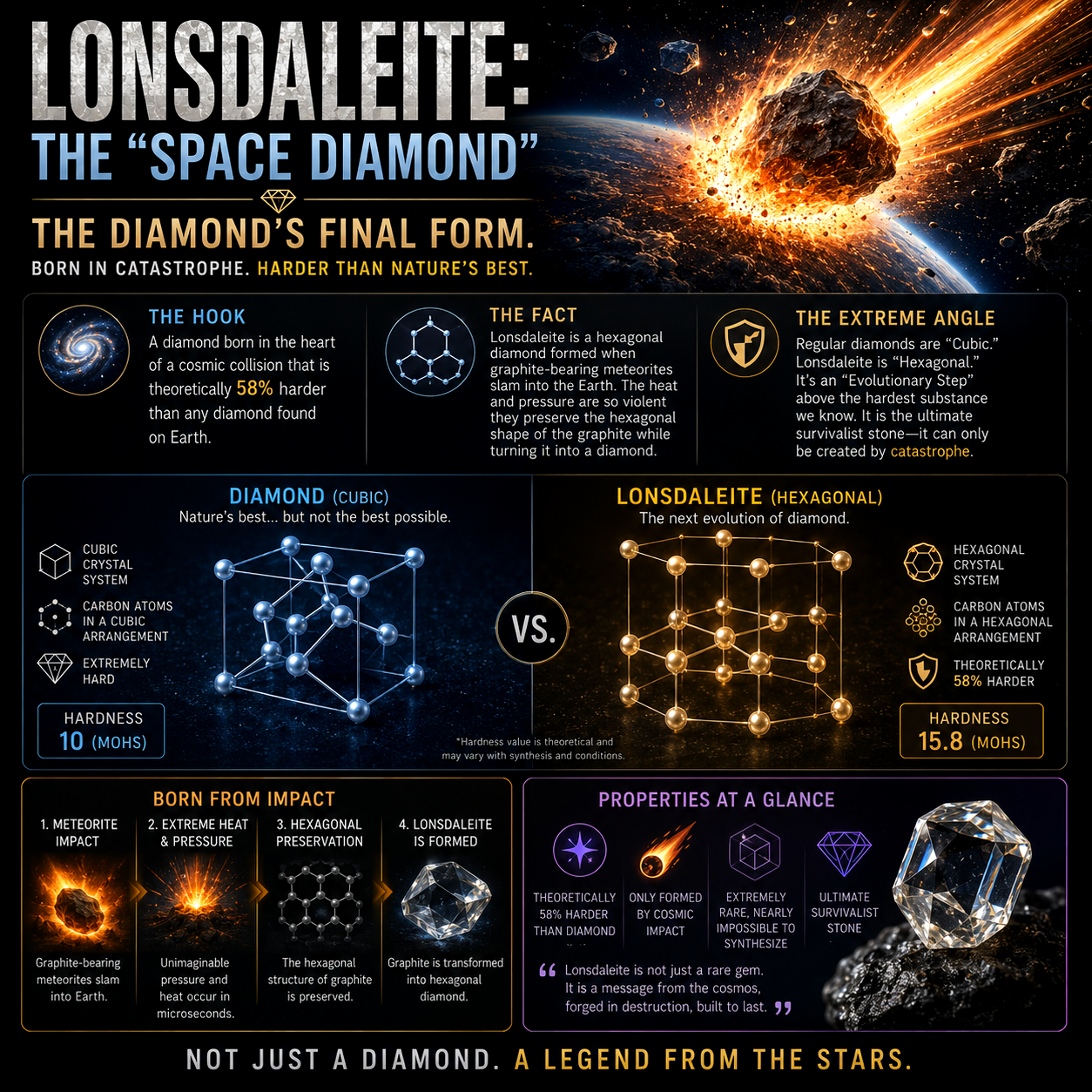
Most people think diamond is the hardest natural material on Earth.
But there is something even more extreme.
A form of diamond born not deep underground… but in cosmic violence.
A crystal created when meteorites slam into planets with unimaginable force.
A gemstone so rare and so unusual that scientists still debate parts of its structure and formation.
This is Lonsdaleite.
The “Space Diamond.”
And if the theories about it are fully correct, it may be one of the hardest naturally occurring materials ever discovered in the universe.
Lonsdaleite does not form under normal geological conditions like ordinary diamonds. Traditional diamonds form deep within Earth’s mantle under immense pressure and temperature over billions of years. Carbon atoms arrange themselves into a cubic crystal structure, creating the diamonds used in jewelry and industry today.
Lonsdaleite is different.
Its crystal structure is hexagonal instead of cubic.
That tiny atomic difference changes everything.
Because in theory, the hexagonal arrangement may allow Lonsdaleite to resist deformation even better than ordinary diamond. Some scientific models suggest it could be up to 58% harder than conventional diamond under ideal conditions.
That possibility alone transformed Lonsdaleite into one of the most fascinating materials in mineralogy, geology, planetary science, and advanced materials research.
Because if diamond is already the king of hardness… then Lonsdaleite may represent the next evolutionary step.
The origin of Lonsdaleite sounds almost like science fiction.
Imagine a massive meteorite traveling through space for millions or even billions of years. Inside that meteorite exists graphite-rich material containing carbon atoms arranged in layered sheets. Then suddenly the meteorite collides with Earth — or another planetary body — at catastrophic velocity.
The impact creates temperatures hotter than volcanic magma and pressures so violent they occur faster than the human brain can comprehend.
In milliseconds, the graphite structure experiences unimaginable compression.
Instead of forming ordinary cubic diamond, parts of the carbon preserve a hexagonal arrangement during transformation.
The result is Lonsdaleite.
A diamond born from catastrophe.
A crystal forged in cosmic destruction.
That is why Lonsdaleite is often called the “Space Diamond.”
Unlike ordinary gemstones associated with beauty and luxury, Lonsdaleite feels more primal and extreme. It represents survival under the most violent conditions nature can create.
Not pressure from deep Earth. But the force of planetary collision.
The mineral was named after Dame Kathleen Lonsdale, a pioneering crystallographer whose work helped revolutionize understanding of crystal structures. Her contributions to science were so important that this extraordinary material was eventually named in her honor.
The first recognized Lonsdaleite discoveries came from meteorite impact sites, particularly the famous Canyon Diablo meteorite associated with Meteor Crater in Arizona. Scientists studying impact debris discovered unusual hexagonal diamond structures unlike traditional cubic diamonds.
This discovery changed how researchers understood carbon transformation under extreme conditions.
It proved that nature could create entirely different forms of diamond through impact physics.
And that idea became incredibly important not only for geology but also for planetary science, industrial materials, and astrophysics.
Because if Lonsdaleite can form during meteorite impacts on Earth, it may also exist across countless impact zones throughout the solar system and beyond.
That possibility makes Lonsdaleite feel less like an Earth gemstone and more like a cosmic material.
A relic from the violent mechanics of the universe itself.
The structure of ordinary diamond is already extraordinary. Carbon atoms bond together in a rigid cubic network, giving diamond its famous hardness and durability. But Lonsdaleite rearranges those same carbon atoms into a hexagonal crystal lattice.
That difference sounds small.
But at the atomic scale, structure determines everything.
Scientists believe the hexagonal arrangement may distribute stress differently, potentially allowing Lonsdaleite to resist certain forms of deformation better than cubic diamond.
This is why headlines often describe it as “harder than diamond.”
However, the science is more complex than simplified internet claims suggest.
Natural Lonsdaleite samples are extremely small, mixed with other materials, and difficult to study perfectly. Some researchers debate how pure natural Lonsdaleite actually exists and whether certain samples represent defect-rich diamond structures instead of fully distinct crystals.
But even with ongoing scientific debate, one thing remains clear: Lonsdaleite represents one of the most extraordinary forms of carbon ever discovered.
And the fact it forms through cosmic impact makes it even more fascinating.
Search terms such as “Lonsdaleite,” “space diamond,” “harder than diamond,” “hexagonal diamond,” “meteorite diamond,” “rare cosmic gemstone,” “diamond from meteorites,” “strongest natural material,” and “space crystal” continue gaining popularity because people are captivated by the idea of a gemstone born from planetary violence.
Lonsdaleite combines multiple powerful fascinations at once: Space. Meteorites. Extreme physics. Diamonds. Catastrophic impacts. Advanced materials science. Rare minerals. Cosmic origins.
Few minerals combine all these themes so naturally.
That combination gives Lonsdaleite enormous emotional power as a scientific and geological concept.
It does not feel like ordinary jewelry. It feels like condensed astrophysics.
The idea that a meteorite collision can transform graphite into a harder form of diamond also reveals something profound about nature: Extreme environments create extraordinary materials.
Earth’s geology already produces remarkable substances through pressure and heat. But meteorite impacts introduce an entirely different category of physics. The temperatures and pressures generated during major impacts exceed many ordinary geological processes by enormous margins.
These conditions can create minerals impossible to form under normal circumstances.
Lonsdaleite is one of the greatest examples.
This is why impact craters are scientifically important. They are not just scars on planetary surfaces. They are natural laboratories of extreme physics capable of producing unusual minerals, shock structures, and altered crystal forms.
Some scientists even believe impact processes may have played important roles in shaping planetary chemistry and mineral diversity throughout Earth’s history.
In that sense, Lonsdaleite represents more than a rare crystal. It represents evidence of cosmic forces shaping planetary evolution.
Another reason Lonsdaleite fascinates researchers is because of its potential technological applications.
If scientists could reliably synthesize large, pure Lonsdaleite crystals, the material might revolutionize cutting tools, industrial abrasives, protective coatings, advanced electronics, and ultra-durable engineering systems.
Diamond is already essential in industry because of its hardness and thermal conductivity. A material potentially surpassing diamond could become enormously valuable technologically.
This possibility has driven attempts to reproduce Lonsdaleite in laboratories.
However, creating stable, pure synthetic Lonsdaleite remains extremely difficult.
Nature itself only seems to create it during catastrophic impacts.
That difficulty adds to the material’s mystique.
Lonsdaleite feels like a substance the universe only creates under exceptional circumstances.
And because natural specimens are so rare and microscopic, true gem-quality Lonsdaleite does not exist commercially like ordinary diamonds or gemstones.
This makes it one of the rarest carbon materials associated with gemology and planetary science.
The rarity also fuels collector fascination.
Meteorite collectors, mineral enthusiasts, and science lovers are deeply drawn toward materials connected to cosmic events. People are naturally fascinated by objects that originated beyond Earth or formed during extraordinary astronomical processes.
Lonsdaleite exists directly inside that fascination.
It is literally impact-transformed carbon from catastrophic collision events.
That origin story gives the material emotional weight far beyond conventional gemstones.
Traditional diamonds symbolize luxury, wealth, romance, and permanence.
Lonsdaleite symbolizes survival through cosmic violence.
That difference matters psychologically.
One gemstone forms quietly underground over billions of years. The other forms in milliseconds during planetary catastrophe.
The contrast makes Lonsdaleite feel more extreme, more dangerous, and more mysterious.
Some scientists believe Lonsdaleite may also exist inside certain ultra-high-pressure environments beyond Earth, including meteorites originating from ancient planetary bodies. Others speculate similar structures could exist in impact zones across Mars, the Moon, or asteroid surfaces.
This transforms Lonsdaleite into more than a mineral. It becomes a cosmic phenomenon.
The material also challenges how people think about diamonds themselves.
Most people assume diamond represents the ultimate carbon structure. But Lonsdaleite proves carbon can organize into even stranger and potentially stronger arrangements under different conditions.
Carbon itself is already one of the most extraordinary elements in existence. It forms graphite, graphene, diamond, nanotubes, organic life, hydrocarbons, and countless complex structures essential to biology and materials science.
Lonsdaleite adds another astonishing form to carbon’s already incredible list.
That versatility is one reason carbon dominates both life and advanced materials research.
Few elements can transform into such radically different substances.
Soft graphite and ultra-hard diamond already seem opposites. Lonsdaleite pushes the concept even further.
The visual idea of a “space diamond” also strongly captures public imagination. Humans instinctively associate space with rarity, danger, mystery, and value. Combining that with diamonds creates a nearly irresistible concept psychologically.
A crystal from the stars. A gemstone born from impact. A material harder than diamond.
It almost sounds fictional.
Yet Lonsdaleite is real.
And that reality is what makes it fascinating.
The mineral also represents the violence of cosmic history. Earth’s geological and biological evolution has been shaped repeatedly by asteroid and meteorite impacts. Some impacts caused mass extinctions. Others reshaped landscapes and atmospheres.
Lonsdaleite forms directly from those catastrophic forces.
In a strange way, it is frozen evidence of cosmic destruction.
A crystalized memory of impact physics.
This perspective gives Lonsdaleite philosophical depth rarely associated with minerals.
The material reminds us that the universe creates beauty through violence as often as through stability.
Stars explode. Planets collide. Galaxies crash together.
And sometimes those catastrophic events leave behind extraordinary materials.
Lonsdaleite is one of them.
The mineral also appeals strongly to futurism and science fiction culture because it feels technologically advanced. A crystal harder than diamond formed during cosmic impact sounds like something from an alien civilization or advanced futuristic engineering.
This perception helps explain why the concept spreads so rapidly online.
People are naturally drawn toward materials that feel beyond ordinary Earth experience.
Lonsdaleite feels like that.
It feels extraterrestrial.
And technically, much of it is.
The term “Space Diamond” perfectly captures the emotional identity of the material because Lonsdaleite exists at the intersection of astronomy, geology, mineralogy, and advanced materials science.
It belongs simultaneously to: Space science. Meteorite research. Carbon chemistry. Extreme physics. Planetary impacts. Crystal engineering. Gemology.
Very few natural substances connect so many scientific worlds at once.
That interdisciplinary fascination is part of what makes Lonsdaleite endlessly compelling.
Even its rarity contributes to its mythic reputation. Most people will never see true Lonsdaleite in person because natural occurrences are microscopic and exceptionally uncommon.
It exists more as a scientific legend than a traditional gemstone.
That almost mythical status increases fascination further.
The material feels hidden. Elusive. Nearly impossible.
Yet it exists.
Some researchers even believe understanding Lonsdaleite better may help scientists develop future supermaterials inspired by impact-generated carbon structures.
That means this strange cosmic diamond may eventually influence advanced technologies humanity has not even fully invented yet.
Again, the material feels futuristic.
But its origin is ancient.
Many Lonsdaleite-bearing meteorites traveled through space long before human civilization existed. Some may have originated from collisions between asteroids or planetary fragments billions of years ago.
That means tiny crystals of Lonsdaleite could predate Earth’s complex life itself.
Few materials connect human beings to cosmic deep time so directly.
Holding a meteorite containing Lonsdaleite means touching matter shaped by violent astrophysical events older than humanity, older than civilization, possibly older than multicellular life.
That scale of time is difficult for the human mind to fully comprehend.
Yet Lonsdaleite exists because of it.
This is why the material inspires such intense fascination among scientists and collectors alike.
It is not just rare. It is cosmic history compressed into crystal form.
A message from impact physics. A survivor of catastrophe. A diamond transformed by the violence of the universe itself.
Not just a gemstone.
A legend from the stars.
Looking for rare gemstones, meteorite materials, collector minerals, cosmic stones, and extraordinary geological treasures? Visit Our Shop
← Back