Metallic Luster Gemstones You Should Know
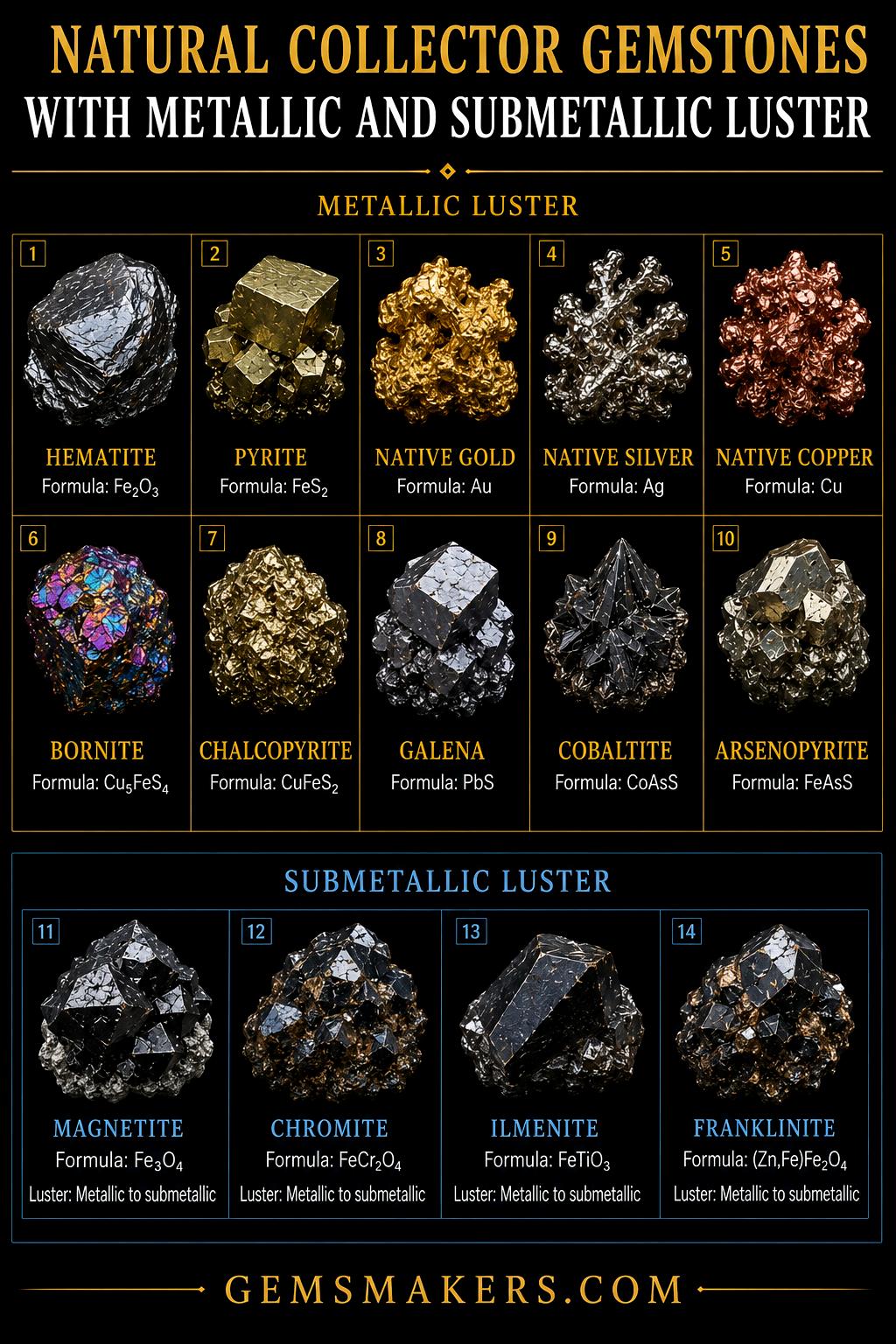
Natural minerals with metallic and submetallic luster have a very different kind of beauty from bright faceted gems. Instead of looking transparent or glassy, they reflect light like metal, dark iron, polished steel, or a shining ore surface. That gives them a strong, bold appearance that collectors often love. Some of these minerals are famous for their metallic shine. Others are better known as ore minerals, but they still belong in the gemstone and collector mineral world because they are natural, visually striking, and important in mineral collections.
The minerals in this image are a great example of how diverse the mineral world can be. Hematite, pyrite, native gold, native silver, native copper, bornite, chalcopyrite, galena, cobaltite, arsenopyrite, magnetite, chromite, ilmenite, and franklinite all show this dramatic metallic or submetallic look. Some are shiny gold. Some are deep black. Some look silver, bronze, or steel gray. Some flash rainbow colors on fresh surfaces. Each one has its own character, chemistry, and collector appeal.
These minerals are not usually admired for the same reasons people admire diamonds or sapphires. They are not about transparency or brilliance in the usual gemstone sense. Their power comes from surface reflection, crystal form, density, color, and the feeling that they are part of the raw Earth. For many collectors, that makes them even more exciting.
Quick Answer
Metallic luster gemstones are natural minerals that reflect light like polished metal. Submetallic luster means the stone reflects light strongly but less like a true mirror and more like a dark or softer metallic surface. The minerals in this image include hematite, pyrite, native gold, native silver, native copper, bornite, chalcopyrite, galena, cobaltite, arsenopyrite, magnetite, chromite, ilmenite, and franklinite. Most are collector minerals or ore minerals rather than standard jewelry stones, but they are valued for their strong luster, crystal form, and geological importance.
What is metallic luster?
Luster describes how a mineral reflects light from its surface. Metallic luster means the mineral looks like metal. It may appear shiny, reflective, and dense, almost like a piece of metal ore. The reflection can be bright and mirror-like, or it can be softer and darker. Submetallic luster means the surface still reflects light in a metallic way, but not as strongly or cleanly as a true metallic mineral.
This is one of the most important visual properties in mineral identification. Before you even test hardness or density, luster can help you narrow down what a specimen might be. Metallic luster usually suggests a metal-rich mineral, often an ore mineral. Submetallic luster can suggest a mineral that is close to metallic in appearance but slightly less intense.
Collectors like metallic luster minerals because they feel powerful and raw. They are often heavy, dark, and visually bold. Unlike transparent gems, these minerals are admired for the way they catch light on the surface rather than through the stone.
Why metallic luster minerals are so popular with collectors
Collectors are drawn to metallic luster minerals because they look dramatic and natural at the same time. A bright crystal of pyrite, a silver-gray piece of galena, or a deep black magnetite specimen can have a strong visual effect even without faceting or polishing. These minerals often show sharp crystal faces, strange growth patterns, or impressive weight. That makes them especially satisfying in mineral displays.
They also tell a geological story. Many metallic minerals form in hydrothermal systems, igneous environments, or ore deposits. They are often linked to the Earth’s deeper chemistry and to the formation of valuable metal deposits. That gives them more than beauty. It gives them context.
Some are also historically important because they were sources of metals used in coins, tools, and industry. Others are interesting because they are rare in clean crystal form. A well-formed metallic crystal can be just as collectible as a faceted gemstone.
Hematite: the classic metallic black mineral
Hematite is one of the best-known metallic minerals in the world. It often appears black, steel gray, or silver-gray with a strong metallic shine. In some forms, it can look earthy and dull, but the metallic crystal specimens are what collectors love most. Hematite is one of the clearest examples of a mineral that can look like polished metal while still being completely natural.
The image shows hematite with a bright reflective surface that demonstrates why it is so famous. It is often heavy, dense, and visually bold. Hematite is also important because it is an iron oxide, which makes it geologically significant. It occurs in many rock settings and is a major iron mineral.
Collectors appreciate hematite because it bridges the line between mineral specimen and metallic object. It feels solid and substantial. Even when it is not used as a jewelry stone, it remains one of the most recognizable metallic luster minerals.
Pyrite: the famous “fool’s gold”
Pyrite is probably the most famous metallic mineral in the image. It is known for its bright gold color and cubic crystal habit. Many people call it fool’s gold because of its resemblance to gold, but collectors know pyrite is much more than that. It is one of the most iconic metallic minerals on Earth.
Pyrite is admired for its clean crystal shape and brilliant metallic shine. Cubes, pyritohedrons, and clusters of small crystals can look almost architectural. The golden surface makes pyrite one of the most attractive collector minerals in the world. It can be both beautiful and strikingly geometric.
Pyrite is also important because it often forms in hydrothermal and sedimentary environments. It shows up in ore deposits, metamorphic rocks, and other geological settings. For collectors, a good pyrite specimen is often a favorite because it combines luster, shape, and color in one mineral.
Native gold: the ultimate metallic luster mineral
Native gold is one of the most important metallic minerals in the world. It is pure or nearly pure elemental gold and appears in its natural state. Its rich yellow color and unmistakable metallic shine make it one of the most sought-after natural materials on Earth. Unlike many other minerals in this image, native gold is valuable both as a specimen and as a precious metal.
Collectors love native gold because it can form natural nuggets, wires, flakes, and crystalline masses. The image shows a gold cluster that looks brilliant and rich. This mineral has a powerful visual presence because of its warm metallic color and its cultural meaning. Gold has always been linked to wealth, prestige, and rarity.
Native gold is also important geologically because it often forms in hydrothermal veins, placer deposits, and other gold-bearing systems. A natural gold specimen is not just a mineral. It is a piece of economic history and Earth history at the same time.
Native silver: cool, bright, and highly reflective
Native silver is a beautiful metallic mineral with a cool silver-white appearance. It is elemental silver in natural form. Like native gold, it is valued both for its mineral specimen appeal and its precious metal identity. The shiny metallic surface gives it a clean, elegant look.
Native silver can form in wires, masses, plates, or branching shapes. Collectors are drawn to it because it looks unusual and precious at the same time. A natural silver specimen has a very different feeling from a cut gemstone. It feels raw, historic, and strongly connected to ore geology.
Silver is also important in mining history. Native silver deposits have been treasured for centuries. That gives the mineral both scientific and cultural value. In a collector cabinet, a fine native silver piece can stand out immediately because of its bright metallic look.
Native copper: warm metallic red-orange beauty
Native copper is one of the most visually distinct metallic minerals because of its warm reddish-brown to coppery-orange color. It is elemental copper in natural form, and its shine can be very attractive. The specimen shown in the image demonstrates that rich metallic copper color beautifully.
Native copper is often found in branching, twisted, or irregular forms. It is highly collectible because it can display both natural shape and metallic shine. Unlike gold or silver, copper has a warmer tone that gives it a very different personality. It feels earthy, powerful, and industrial, but in natural form it can also be elegant.
Collectors appreciate native copper because it connects mineral collecting with metal history. Copper has been used by humans for thousands of years, and seeing it in natural form gives a direct connection to that history.
Bornite: the colorful “peacock ore”
Bornite is one of the most colorful metallic minerals in the image. Fresh surfaces of bornite can show an iridescent rainbow coating, which makes it famous as “peacock ore.” Its chemical makeup includes copper and iron, and it often tarnishes into vivid blue, purple, green, and gold colors.
This mineral is highly popular with collectors because of its dramatic appearance. The rainbow effect can be stunning under good lighting. Bornite is a great example of a metallic mineral that is not only reflective but also colorful in an unexpected way.
Even though bornite is an ore mineral, it has major collector appeal because of its visual power. It shows how metallic luster can be combined with colorful tarnish to create something unforgettable.
Chalcopyrite: golden brassy shine
Chalcopyrite is another copper-bearing mineral with a bright brass-yellow metallic color. It is often mistaken for pyrite, but it usually has a slightly different tone and crystal habit. Fresh chalcopyrite can be very bright and attractive, and it often develops iridescent tarnish as well.
Collectors enjoy chalcopyrite because it has a strong metallic presence without being as common or as simple-looking as some other ore minerals. It can appear in nice crystals or massive clusters. Its brassy tone makes it especially appealing in mixed mineral displays.
Chalcopyrite is one of the main copper ore minerals, but it is also a fine collector mineral when the crystals are well formed. It is a strong example of metallic luster with real visual charm.
Galena: silver-gray heaviness and perfect cubes
Galena is one of the most famous metallic minerals because of its weight, bright silver-gray color, and often perfect cubic crystals. It is a lead sulfide mineral, and its appearance is so metallic that it is immediately recognizable to many mineral collectors.
The image shows galena as a bright, silver-gray cluster that looks almost like carved metal. That is one reason galena is so admired. It combines cubic geometry, metallic shine, and impressive density. A well-formed galena specimen can feel heavy and authoritative in the hand.
Collectors love galena because it is visually strong and often crystal clear in form. It is one of the best examples of metallic luster meeting neat crystal shape. At the same time, it is an important ore mineral in mining history.
Cobaltite: dark metallic beauty
Cobaltite is a less familiar but very interesting metallic mineral. It often appears silver-white, steel-gray, or dark metallic. Its crystals can be sharp and attractive, and its chemistry makes it important in cobalt-bearing mineral systems.
Collectors value cobaltite because it is not commonly seen in everyday mineral displays. It has a strong, dark metallic look that gives it a serious mineralogical presence. It may not be famous with the general public, but it is respected by collectors who appreciate unusual sulfide minerals.
Cobaltite shows that metallic luster minerals are not only about bright gold or silver. Dark metallic minerals can be just as striking when they are well formed.
Arsenopyrite: silver-white with a sharp edge
Arsenopyrite is one of the more distinctive metallic sulfide minerals. It often appears silver-white to steel-gray and can form sharp, blocky crystals. Its metallic shine can be very clean and bright, making it a favorite among collectors of ore minerals and sulfides.
This mineral is also important because of its role in geological processes and ore deposits. It is often associated with other metallic minerals in complex systems. The sharp crystal form and reflective surface make it very attractive under the right lighting.
Arsenopyrite may not be a gemstone in the usual jewelry sense, but it is absolutely part of the collector mineral world. It demonstrates the beauty of a mineral that is both metallic and structurally interesting.
Magnetite: black, heavy, and strongly magnetic
Magnetite is one of the most recognizable dark metallic minerals. It is usually black or dark gray and may show submetallic to metallic luster depending on the specimen. One of its most famous properties is that it is magnetic. That makes it especially memorable to collectors and students.
The image shows magnetite as a dark, shiny mineral with a strong metallic presence. Magnetite can form octahedral crystals or massive forms. Its black shine is a classic part of ore mineral collections. It is a major iron oxide and one of the most important iron ore minerals on Earth.
Collectors enjoy magnetite because of its weight, magnetic behavior, and visual strength. It is a mineral that feels physical and direct. You do not just look at it. You feel its mass and presence.
Chromite: deep dark luster and ore importance
Chromite is another important dark metallic to submetallic mineral. It is usually black or very dark brown with a strong, subdued metallic appearance. It is a major chromium ore mineral and therefore very important in geology and industry.
Collectors like chromite because it often forms attractive crystals or massive specimens with a dense, dark look. It may not have the mirror brightness of pyrite or native silver, but its darker luster gives it a strong and serious appearance. That makes it popular in mineral displays that focus on ore minerals and earth science.
Chromite shows the collector value of minerals that are more subtle in shine but still visually powerful. It is part of the deeper metallic world.
Ilmenite: dark and heavy with submetallic character
Ilmenite is a black to steel-gray titanium-iron oxide mineral. It often shows submetallic to metallic luster and is known for its dark, heavy appearance. It is one of the minerals in the image that reflects a more subdued metallic effect rather than a bright mirror shine.
Collectors value ilmenite because it is a major titanium mineral and a good example of submetallic luster. Its crystals can be attractive and its dark color gives it a serious presence in a collection. It is often found in igneous and metamorphic settings.
Ilmenite may not be as visually flashy as native gold, but it is still compelling because of its deep dark shine and mineral importance. It is a good example of why submetallic luster matters as a category.
Franklinite: a complex zinc-iron oxide with dark metallic shine
Franklinite is a zinc-iron oxide mineral with a dark metallic to submetallic luster. It is often black or very dark brown and can appear quite dense. It is especially interesting because of its complex chemistry and its role in famous mineral localities.
Collectors appreciate franklinite because it is a classic dark mineral with strong specimen value. It may not look bright in the same way as pyrite, but its dark metallic surface and crystal form make it a worthy collector piece. It is also a good reminder that metallic luster does not always mean bright yellow or silver. It can also mean deep black polish and strong reflective character.
Metallic versus submetallic luster
The difference between metallic and submetallic luster is subtle but important. Metallic luster reflects light very strongly and looks like metal. Submetallic luster still looks metallic but less sharply reflective. It may appear darker, duller, or softer in reflection.
In this image, hematite, pyrite, native gold, native silver, native copper, bornite, chalcopyrite, galena, cobaltite, and arsenopyrite are classic metallic examples. Magnetite, chromite, ilmenite, and franklinite are better described as submetallic to metallic, depending on specimen quality and lighting.
This distinction helps collectors and students identify minerals more accurately. It also shows how the same mineral family can vary depending on form, surface, and crystal quality.
Why these minerals are not ordinary jewelry stones
Most metallic luster minerals are not worn as standard faceted jewelry stones. Many are too opaque, too soft, too dense, or too chemically sensitive for everyday wear. Some are ore minerals rather than gemstone minerals. That does not make them less valuable. It just means they belong to a different part of the mineral world.
These specimens are often admired as display pieces, study pieces, or collector pieces. Some can be polished into cabochons or decorative items, but the main appeal is usually the raw crystal or mineral specimen itself. Their charm comes from natural form and luster rather than transparency.
Why collectors love metallic luster minerals
Collectors love these minerals for several reasons. They look powerful. They feel heavy. They often have bold crystal forms. Many are important ore minerals with major geological stories. Some have historic uses in mining and metallurgy. Others are beautiful because of unusual surface reflection or colorful tarnish.
They also bring variety to a collection. A mineral cabinet full of transparent gems is beautiful, but a metallic luster section adds contrast, depth, and earthiness. That contrast is one reason metallic minerals remain so popular with serious collectors.
Final thoughts
Natural collector gemstones and minerals with metallic or submetallic luster represent a very different kind of beauty in the mineral world. Hematite, pyrite, native gold, native silver, native copper, bornite, chalcopyrite, galena, cobaltite, arsenopyrite, magnetite, chromite, ilmenite, and franklinite all show how reflective surfaces, dark shine, and crystal form can create strong visual appeal.
These minerals matter because they connect beauty with geology and industry. Some are major ore minerals. Some are famous collector specimens. Some are both. Their metallic shine is not just attractive. It is part of what makes them scientifically and historically important.
For collectors and gem lovers, these minerals are proof that gemstones and mineral specimens do not need to be transparent to be beautiful. Sometimes the strongest beauty comes from the surface itself, reflecting light like a piece of the Earth’s hidden metal world.
Looking for natural loose gemstones, collector stones, and jewelry-grade gems?
← Back