Nature’s Perfect Geometry: Some Cool Natural Beautiful Crystal Shapes
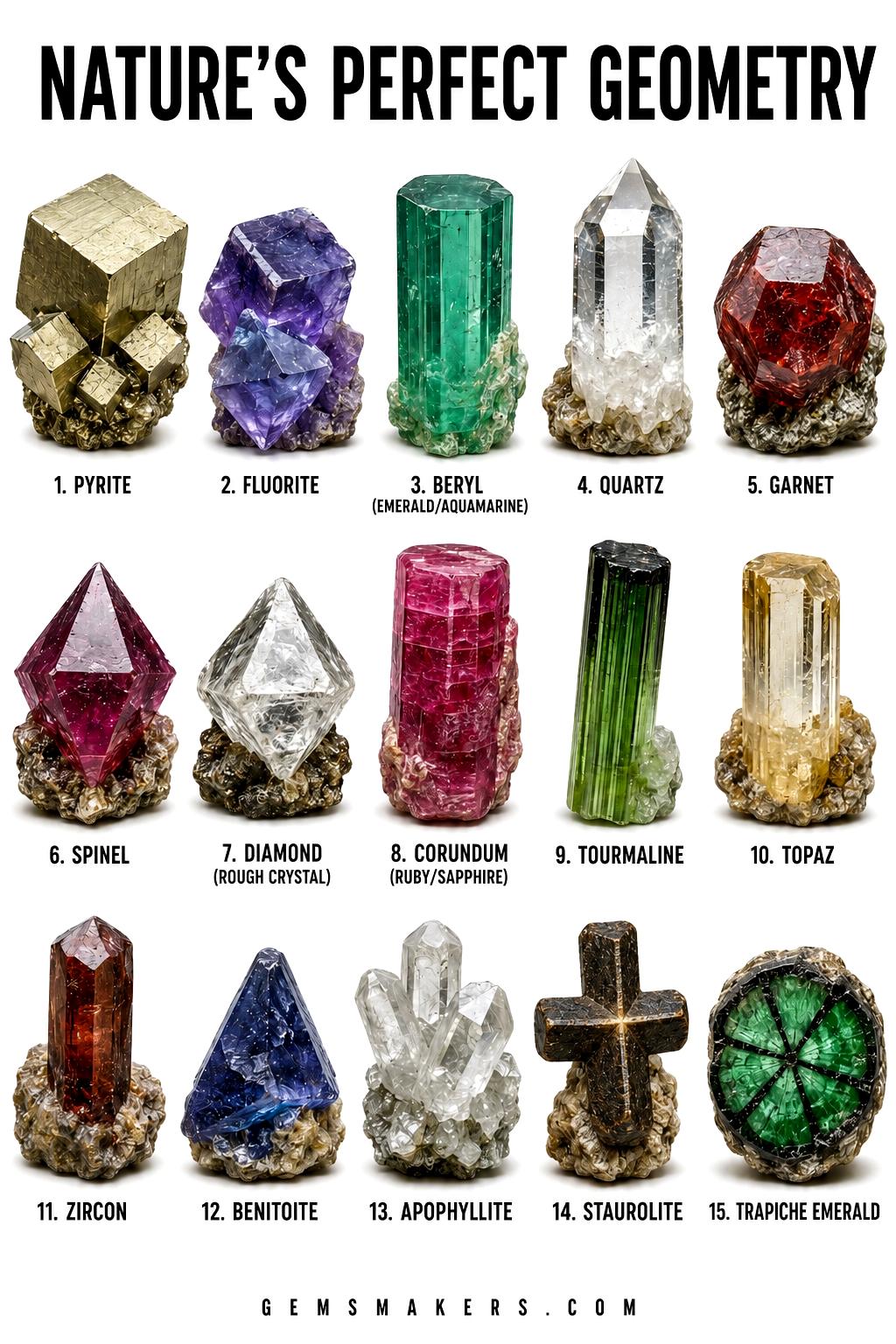
Nature’s Perfect Geometry: The Most Beautiful Crystal Shapes in Pyrite, Fluorite, Beryl, Quartz, Garnet, Spinel, Diamond, Corundum, Tourmaline, Topaz, Zircon, Benitoite, Apophyllite, Staurolite, and Trapiche Emerald
Some gemstones are admired first for color. Others are admired first for shape. The stones in this image belong to a very special group because their crystal geometry is part of what makes them unforgettable. Pyrite forms sharp cubes. Fluorite can grow into clean octahedrons and complex blocks. Beryl often develops long hexagonal prisms. Quartz is famous for pointed six-sided crystals. Garnet can form deep dodecahedral shapes. Spinel often appears as neat octahedrons or rounded crystals with brilliant color. Diamond rough can show a dramatic natural crystal form. Corundum, tourmaline, topaz, zircon, benitoite, apophyllite, staurolite, and trapiche emerald all show the power of natural geometry in different ways.
This image is a reminder that gemstones are not only beautiful because of their color and sparkle. They are also beautiful because of the way nature builds them. Crystal shape tells a story about chemistry, temperature, pressure, and growth conditions. A perfect crystal face or a sharply defined habit can be just as fascinating as the color itself. For collectors, mineral lovers, and gem buyers, this is one of the most exciting parts of the gemstone world.
Quick Answer
Nature’s perfect geometry appears when gemstones grow into naturally ordered crystal shapes such as cubes, octahedrons, prisms, and pyramids. Stones like pyrite, fluorite, beryl, quartz, garnet, spinel, diamond, corundum, tourmaline, topaz, zircon, benitoite, apophyllite, staurolite, and trapiche emerald are admired not only for color but also for the symmetry and structure of their natural crystals.
Why Crystal Geometry Matters in Gemstones
Crystal geometry is one of the clearest signs that a gemstone formed naturally. Every mineral has its own atomic structure, and that structure influences the shape of the crystal as it grows. Some minerals prefer cubes. Some grow as prisms. Some form sharp points. Some develop complex combinations of faces. These shapes are not random. They are the visible result of the mineral’s internal arrangement.
For collectors, crystal shape can be just as important as color. A well-formed crystal face or a rare growth habit can make a specimen much more desirable. For jewelers, crystal geometry often determines how the rough stone is cut. A beautiful crystal can inspire a cutter to preserve its proportions or reveal the best face of the material. In many cases, the shape of the crystal is part of its identity.
That is why this image is so powerful. It shows that gemstones are not just colored objects. They are natural geometric forms shaped by the Earth itself.
Pyrite: the cube king of crystal geometry
Pyrite is one of the most famous geometric minerals in the world. It often forms perfect cubes, which makes it instantly recognizable. The sharp square faces and metallic luster give pyrite a bold and structured appearance. This cubic form is one of the most satisfying crystal shapes in nature because it looks almost artificially designed, yet it is completely natural.
Pyrite is sometimes called “fool’s gold,” but collectors know it is much more than that. Its geometry is one of the reasons it is so admired. Pyrite can also form pyritohedrons and other shapes, but the cube is its most iconic form. The specimen shown in the image highlights how striking this geometry can be. Pyrite proves that nature can build clean, straight edges with astonishing precision.
Fluorite: colorful geometry in multiple forms
Fluorite is another mineral famous for crystal geometry. It can form cubes, octahedrons, and many other combinations of flat faces and sharp edges. Fluorite is also beloved for its wide color range, but its shape is a huge part of its appeal. It can look elegant, simple, or highly complex depending on how it grows.
Because fluorite can show such strong geometric form, it is one of the most popular collector minerals in the world. A well-formed fluorite crystal feels balanced and refined. The image shows fluorite in a chunky, multi-faced form that makes its internal symmetry obvious. Collectors love fluorite because it often combines color zoning, transparency, and crystal habit in one piece.
Beryl: elegant hexagonal crystal prisms
Beryl often grows in long hexagonal crystals, and that geometry is one of its most beautiful features. The beryl family includes emerald, aquamarine, morganite, heliodor, goshenite, and red beryl. Many of these stones are known for their prism-like rough form before cutting. A beryl crystal can be tall, clean, and elegant, with a strong sense of structure.
This hexagonal habit is one reason beryl is so visually satisfying. It feels organized and balanced. The crystal shown in the image emphasizes this clean, vertical geometry. Beryl is important because it shows how crystal form and gemstone family are closely linked. Even when the same mineral appears in different colors, the natural crystal shape often remains one of the strongest clues to its identity.
Quartz: the classic six-sided point
Quartz is one of the most familiar and admired geometric crystals in the mineral world. It commonly forms six-sided prisms with pointed terminations, and this shape has become one of the most recognizable crystal forms on Earth. Whether in clear quartz, amethyst, smoky quartz, or citrine, the basic geometry is often the same.
Quartz crystals are especially popular because they are both common and beautiful. They may appear simple, but a perfect quartz point is one of nature’s best examples of balance and symmetry. The image shows quartz in its classic pointed form, and that shape immediately communicates the mineral’s identity. Quartz is one of the great symbols of natural crystal geometry.
Garnet: rounded geometry with strong internal symmetry
Garnet does not usually grow into long points or cubes like some other minerals. Instead, it often forms rounded or dodecahedral crystals with many flat faces. This gives garnet a different kind of geometry. It is not sharp in the same way quartz or pyrite is. Instead, it feels full, solid, and deeply structured.
The garnet shown in the image demonstrates this nicely. Its shape is symmetrical and compact, and the rich red color adds to the visual impact. Garnet geometry is especially admired by mineral collectors because the crystal forms can be very clean and attractive. Some garnets become excellent specimens because of their crystal habits alone, even before considering color.
Spinel: brilliant geometry in neat crystal forms
Spinel is another gemstone that often shows beautiful crystal geometry. It can appear as octahedrons or other compact forms, and the crystal shape often looks clean and well balanced. Spinel is particularly admired because it combines excellent color with strong structure. A pink, red, or blue spinel crystal can be beautiful even in rough form because the geometry is so neat.
Spinel has gained a lot of attention in recent years as buyers have learned to appreciate its beauty and durability. The geometric form shown in the image highlights how naturally elegant spinel crystals can be. For collectors, that symmetry is part of the stone’s charm. For jewelers, it means the rough can often yield attractive faceted stones with strong brilliance.
Diamond rough: nature’s most famous crystal form
Diamond rough is one of the most fascinating examples of nature’s geometry. In its rough state, diamond can show octahedral, dodecahedral, or other crystal forms depending on growth conditions. The internal symmetry of diamond is remarkable, and its natural shapes are one reason it has captivated people for so long.
When people think of diamond, they usually think of the cut and polished gem. But the rough crystal form is just as interesting. It shows the raw beauty of the mineral before it becomes a faceted jewel. The image includes a rough diamond shape that reminds us that even the most famous gemstone in the world begins as a natural geometric crystal. That shape is part of diamond’s identity and part of its power as a gemstone.
Corundum: the family behind ruby and sapphire
Corundum is the mineral species that includes ruby and sapphire. In rough form, corundum can take on prismatic or barrel-like crystal shapes depending on the environment. The specimen shown in the image highlights how corundum can appear as a bold, elongated crystal with strong color. This is important because the shape tells us something about the mineral’s growth and structure.
Corundum is one of the hardest gemstone minerals, and its crystal geometry is often linked to the conditions in which it formed. Whether it becomes ruby or sapphire depends on trace elements and color. But the underlying crystal architecture remains the same. That makes corundum one of the most important minerals in the gemstone world and a great example of natural geometric order.
Tourmaline: long, striated crystal columns
Tourmaline is famous for its elongated, striated crystal form. It often grows as long vertical prisms with a very distinct shape. This geometry makes tourmaline easy to recognize in rough form and highly attractive to collectors. A tourmaline crystal can look almost architectural, with straight sides and a strong sense of direction.
The tourmaline specimen shown in the image emphasizes this tall, column-like habit. That is one reason tourmaline is so admired. Even before cutting, it has a strong visual presence. Add in the enormous color range of tourmaline, and you have one of the most interesting gemstone families in the world. Its geometry and color work together to make it unforgettable.
Topaz: clean prism geometry and clarity
Topaz often forms in clean, elongated crystals with a very neat geometric profile. It can appear transparent or richly colored, but its shape is often one of the first things collectors notice. Topaz crystals can be elegant and highly structured, with well-developed faces and sharp terminations.
The topaz shown in the image reflects that strong crystal form. Topaz is a good example of how a gemstone’s rough shape can be just as appealing as its polished form. In the collector world, large topaz crystals are highly valued because they combine size, transparency, and geometry. In jewelry, topaz is often cut to preserve its brightness and clean appearance.
Zircon: a crystal that often surprises people
Zircon is a fascinating gemstone because it can look brilliant in polished form and also impressive in crystal form. Its natural geometry can be quite distinct, and its rough crystals often have sharp, compact shapes. Zircon also has a long geological history, which adds to its appeal.
The specimen shown in the image has a strong vertical crystal shape with a warm brown tone. Zircon is loved by collectors because it can be both beautiful and scientifically important. It often preserves ancient Earth information, and its crystal form can be a key part of that story. It is a gemstone that combines age, brilliance, and geometry in one package.
Benitoite: rare and beautifully triangular
Benitoite is a rare gemstone with a very special place in collector mineralogy. It is known for its vivid blue color and unusual crystal shape, which often appears as triangular or trigonal in appearance. This makes it stand out immediately in any collection.
The benitoite shown in the image has a striking angular shape that feels both sharp and rare. That shape is part of its charm. Benitoite is already admired for rarity, but its crystal geometry gives it an extra layer of visual interest. Collectors love rare crystals that are instantly recognizable, and benitoite fits that description perfectly.
Apophyllite: bright, clear, and sharply formed
Apophyllite is one of the most attractive collector minerals when it comes to crystal geometry. It often forms as clear, bright, sharply faceted crystals that can look almost icy or glass-like. The specimen in the image shows this beautifully. Apophyllite crystals often grow in clusters and can look very clean and luminous.
Collectors love apophyllite because it often combines strong crystal form with transparency and delicate beauty. Its geometry is one of the main reasons it is so admired in mineral collections. Even though it is not a mainstream jewelry stone, it is one of the most visually pleasing natural crystals in the mineral world.
Staurolite: the famous cross-shaped mineral
Staurolite is one of the most unusual minerals in the image because it often forms famous cross-shaped twins. This gives it a strong geometric identity that is very different from the other crystals shown here. The cross shape makes staurolite one of the most recognizable collector minerals in the world.
This unusual geometry is not just decorative. It is a natural result of how the crystal grew and twinned. That makes staurolite especially fascinating to mineral collectors. Its shape has given it a long history of interest and symbolism, but even without that cultural side, its natural form is remarkable. It is one of the clearest examples of how mineral geometry can become iconic.
Trapiche emerald: the star-like geometry of internal zoning
Trapiche emerald is one of the most visually extraordinary gemstones in the world. It is known for a radial, wheel-like pattern that looks almost like a geometric star inside the crystal. This is not a typical crystal shape in the same way as pyrite or quartz, but it is still a striking example of natural geometry. The pattern is caused by the way the crystal grows and by the distribution of dark carbonaceous material or other impurities between sectors.
The trapiche emerald shown in the image is a perfect example of nature creating symmetry in a very unusual way. The wheel-like zoning makes the stone one of the most collectible forms of emerald. It is rare, unusual, and instantly memorable. For many people, trapiche emerald represents the point where geology and geometry become art.
Why collectors love natural crystal shapes
Collectors love natural crystal shapes because they show the internal order of nature without human intervention. A perfect cube, a clean prism, or a rare cross shape is not designed by a person. It is created by atoms arranging themselves in a repeated structure over time. That makes the specimen feel both scientific and artistic.
Crystal geometry also helps collectors understand the mineral better. The shape can reveal something about the species, the environment of formation, and the conditions of growth. A collector who values natural form may care as much about the crystal habit as about the stone’s color. That is why geometric crystals are so popular in the mineral world.
Why geometry matters in jewelry too
Even though many of these specimens are admired as rough crystals, geometry still matters in jewelry. Crystal form often affects cutting style, stone size, and the overall design of a finished gem. A well-formed crystal may produce a more efficient and beautiful cut. Some gems are even sold as collector pieces partly because their rough shape is so attractive.
A gemstone with natural geometry often feels more authentic and more connected to its origin. That is something many buyers appreciate. The cut gem may be polished and refined, but the rough crystal still matters because it tells the story of how the stone grew.
Final thoughts
Nature’s perfect geometry is one of the most beautiful things in the gemstone world. Pyrite cubes, fluorite blocks, beryl prisms, quartz points, garnet dodecahedrons, spinel octahedrons, diamond rough crystals, corundum prisms, tourmaline columns, topaz prisms, zircon crystals, benitoite, apophyllite, staurolite, and trapiche emerald all show that nature is capable of making forms that feel precise, balanced, and visually unforgettable.
These stones remind us that gemstones are not only about color and sparkle. They are also about shape, symmetry, and crystal structure. Their geometry is part of their identity. It is one of the reasons collectors and gemstone lovers return to them again and again. Each crystal shape is a small piece of Earth’s hidden order made visible.
Looking for natural loose gemstones, collector stones, and jewelry-grade gems?
← Back