Only One Mine Gemstones: The Rare Gemstones Famous for a Single Locality
Some gemstones become famous not because they are found everywhere, but because they are strongly tied to one place. A single mine, one valley, one mountain range, or one small geological area can give the world a gemstone that becomes legendary. These stones often carry more than beauty. They carry location, history, rarity, and identity. That is why “only one mine” gemstones are so interesting to collectors, jewelers, and gem lovers.
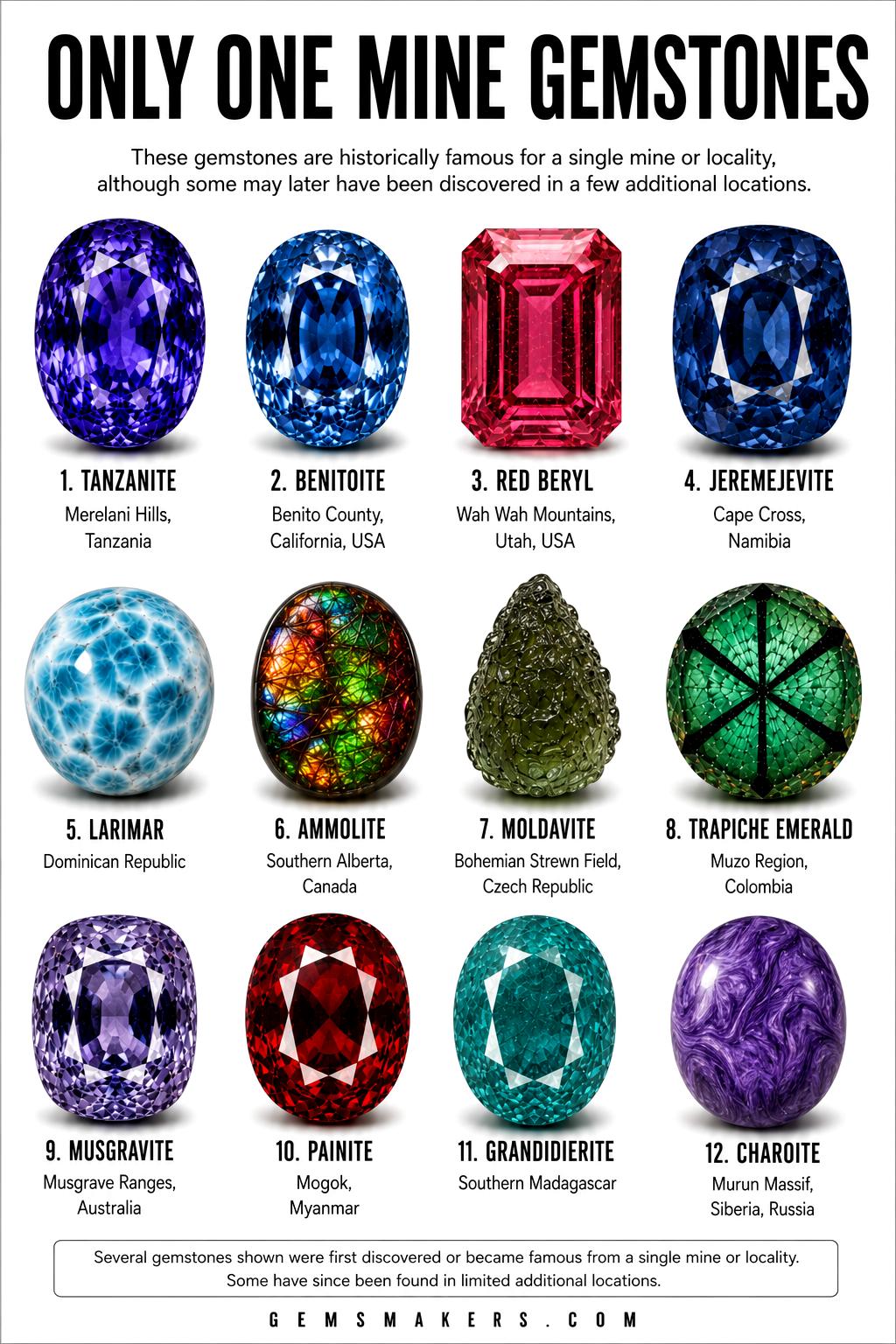
The gemstones shown in this image are some of the best-known examples of stones that became famous from one primary source or one highly important locality. In some cases, later discoveries happened in other places, but the stone still remains historically linked to the locality that made it famous. That connection matters a lot in the gemstone world. It affects value, collector interest, and the way people talk about the stone.
Tanzanite, benitoite, red beryl, jeremejevite, larimar, ammolite, moldavite, trapiche emerald, musgravite, painite, grandidierite, and charoite all belong to that special world of locality-based rarity. Some are well-known to collectors. Others are famous mainly among gemstone specialists. All of them share one powerful idea: a gemstone can become legendary because of where it comes from.
Quick Answer
Only one mine gemstones are gemstones that became famous from a single mine or a very limited locality. Examples include tanzanite from Merelani Hills in Tanzania, benitoite from California, red beryl from Utah, jeremejevite from Namibia, larimar from the Dominican Republic, ammolite from Alberta, moldavite from the Czech Republic, trapiche emerald from Colombia, musgravite from Australia, painite from Myanmar, grandidierite from Madagascar, and charoite from Siberia. These stones are valued because their geographic origin makes them rare and highly collectible.
Why locality matters so much in gemstones
Location matters in gemology because some gemstones only form under very specific geological conditions. That means the right chemistry, temperature, pressure, and host rock may exist in only one or two places on Earth. When that happens, the gemstone becomes strongly tied to a locality. Over time, that locality becomes part of the stone’s identity.
In the gem trade, origin can influence value. A stone from a famous mine may be more desirable than a similar-looking stone from an unknown source. Collectors also care about origin because it adds a story. A gemstone is not only judged by its color or clarity. It is also judged by the journey that brought it into the market and the place that made it famous.
Some gemstones are well distributed around the world. Others are not. The ones in this image belong to the second group. They are stones that became famous because of one special locality. That makes them unusually memorable and often highly sought after.
Tanzanite: the blue-violet gemstone of Merelani Hills
Tanzanite is one of the most famous locality gemstones in the world. It comes from the Merelani Hills in Tanzania and is the only major commercial source known for the gem. Its blue-violet to violet-blue color and strong pleochroism make it instantly recognizable. Tanzanite gained worldwide fame very quickly because of its beauty and because it came from such a specific place.
The stone’s identity is tightly connected to Tanzania. That is part of why tanzanite is so special. It is not a gemstone people associate with many different countries. It is strongly linked to one area, and that adds to its prestige. The gem is also admired because it can show striking color under different viewing angles. That makes it popular in faceted jewelry and collector pieces.
Tanzanite is a perfect example of how a single locality can shape global gemstone history. Without the Merelani Hills, the world would not know tanzanite in the same way.
Benitoite: California’s rare blue treasure
Benitoite is one of the rarest and most famous American gemstones. It is historically associated with Benito County, California, where it was first discovered and where the most famous material comes from. Benitoite is known for its vivid blue color and strong fluorescence under ultraviolet light. Those qualities make it a beloved collector stone.
The locality connection is very important for benitoite. Although small additional occurrences may exist, the gem is still strongly linked to its original California source. That source gave the stone its fame and its identity. For many collectors, benitoite is one of the most exciting rare gemstones because it combines rarity, beauty, and strong locality history.
Benitoite is a great example of a gemstone that became legendary because of one mine region. Its fame is deeply tied to place.
Red beryl: the Utah rarity
Red beryl is another gemstone that became famous from a very limited locality. The best-known source is the Wah Wah Mountains in Utah, USA. Red beryl is famous for its intense red color and extreme rarity. Natural gem-quality red beryl is far less common than most people expect, which makes it a collector favorite.
Its locality matters because red beryl is not widely available from many sources. The Utah connection is part of the stone’s identity and its value. Red beryl is one of those gemstones that enthusiasts mention with respect because of how rare it is in nature. Even small stones can be highly prized.
This is a gemstone that shows how a tiny deposit can create a giant reputation. A gemstone does not need many sources to become famous. Sometimes one locality is enough.
Jeremejevite: a rare gem tied to Namibia
Jeremejevite is one of the rarest gemstones on Earth and is historically associated with Cape Cross, Namibia. Its pale blue to colorless crystal appearance can be very beautiful, but what really makes it special is rarity. Jeremejevite is a gemstone that collectors know as a serious and unusual stone.
Because it is so uncommon, locality becomes part of the stone’s story. When a gemstone appears from a highly specific area, it helps collectors identify and appreciate it. Jeremejevite’s fame grew because of how rare it was and how strongly it was connected to a limited locality.
For gemstone collectors, jeremejevite is one of those names that immediately signals rarity. It is not a common jewelry stone. It is a collector stone with strong geological identity.
Larimar: the blue stone of the Dominican Republic
Larimar is strongly associated with the Dominican Republic, especially the famous locality that made it widely known. Its blue color and soft, cloudy patterns give it a tropical feel that people immediately recognize. Larimar is one of the most popular locality gemstones because its place of origin is so closely tied to its identity.
Many buyers know larimar by name because they associate it with the Caribbean and the Dominican Republic. That connection makes it feel unique and memorable. It is a gemstone that feels like a place, not just a mineral. Its color pattern and limited source give it strong appeal in jewelry and collecting.
Larimar shows how a gemstone can become famous because of a single country or locality. That origin helps define the stone just as much as its appearance does.
Ammolite: fossil shell color from Alberta
Ammolite is a unique gemstone material strongly associated with Southern Alberta, Canada. It comes from fossilized ammonite shell material and is famous for its bright iridescence. Ammolite is one of the most visually spectacular organic gemstone materials in the world.
Its location matters because the finest ammolite is tied to a specific geological formation and region. That makes the stone highly collectible. Ammolite is not just about color. It is also about rarity, fossil history, and locality. Buyers often value it for the strong flash of red, green, orange, and gold that appears as the stone moves in light.
Ammolite is a perfect example of a gemstone that is both geological and biological. Its regional origin adds to its charm and value.
Moldavite: impact glass from Bohemia
Moldavite is famous for its green color and its origin in the Bohemian Strewn Field in the Czech Republic. It is a natural glass formed by a meteorite impact, which gives it an extraordinary story. Moldavite is strongly associated with one region, and that makes it one of the most famous locality-based gem materials.
Collectors love moldavite because it feels unusual, rare, and very tied to a specific place in Europe. Its strange, textured appearance and impact origin make it stand out from ordinary gemstones. The locality is not just a source. It is part of the stone’s identity.
Moldavite has become especially well known in the collector market because it combines extraterrestrial history with a tightly defined geographic region. That is a powerful combination.
Trapiche emerald: the famous Colombian pattern
Trapiche emerald is one of the most distinctive gemstone types in the world. It is strongly associated with the Muzo region of Colombia. The trapiche pattern looks like a wheel or star-like radial structure inside the crystal. That unusual appearance makes it one of the most recognizable and collectible emerald forms.
Because trapiche emerald is so strongly tied to Colombian origin, locality is a major part of its identity. The Colombian connection is not only about geography. It is about the geological conditions that created this unusual growth pattern. Trapiche emerald is admired because it combines emerald beauty with a rare optical and structural pattern that collectors love.
This is one of the clearest examples of a gemstone where origin and appearance are deeply linked. The stone is valuable not just because it is emerald, but because it is Colombian trapiche emerald.
Musgravite: a rare Australian treasure
Musgravite is a rare gemstone associated with the Musgrave Ranges in Australia. It is famous among collectors because it is extremely uncommon and highly prized. Musgravite belongs to a mineral family that can also include other rare species, but the named gemstone itself is very rare and historically tied to its locality.
Its fame comes from both rarity and source. The Musgrave Ranges gave the gemstone its name and identity. That makes the location part of the stone’s story. For many gemstone lovers, musgravite is one of the most exciting names in rare gemology because it belongs to a select group of truly uncommon stones.
Musgravite demonstrates that not all famous gemstones are large or flashy. Some become famous because almost nobody can find them in gem quality.
Painite: the legendary Myanmar rarity
Painite is one of the most famous rare gemstones in the world and is historically associated with Mogok, Myanmar. It became legendary because it was once considered one of the rarest known minerals. Even today, painite remains strongly linked to Myanmar in the minds of collectors and gem enthusiasts.
The rarity and locality are both important here. Painite’s reputation grew because it was so hard to find. The Myanmar connection gave it a real-world source and a very specific identity. It is one of those gemstones whose name alone can attract attention from serious collectors.
Painite is a perfect example of how a single locality can produce a mineral with enormous fame. Its rarity is part of the reason people remember it so well.
Grandidierite: Madagascar’s prized blue-green gem
Grandidierite is one of the most admired rare gemstones from Madagascar, especially Southern Madagascar. Its blue-green to greenish-blue color can be very attractive, and fine gem material is rare. Because of this, locality becomes very important when discussing grandidierite.
Madagascar is known for many special gemstones, and grandidierite is one of its most famous rarest examples. The stone’s origin adds to its value because collectors know that fine material is limited. Grandidierite is not a common commercial gemstone, so its source helps define its identity.
This gemstone shows how a specific region can become famous for producing high-value collector stones. Madagascar’s role in gem history is broad, but grandidierite is one of the names that stands out most strongly.
Charoite: the Siberian purple stone
Charoite is strongly associated with the Murun Massif in Siberia, Russia. Its swirling purple appearance makes it one of the most visually distinctive ornamental gemstones in the world. Charoite is not just attractive. It is also strongly linked to a single geographic origin, which adds to its charm.
The Siberian connection is important because charoite is one of those gems that many people identify immediately with its locality. Its striking purple color and fibrous, swirling patterns make it unforgettable. It is widely used in carvings, cabochons, and jewelry pieces, but its collector appeal is also very strong.
Charoite shows that a gemstone does not need to be transparent or faceted to be famous. A strong color and a strong origin can make it a beloved stone.
Why collectors love only one mine gemstones
Collectors love these stones because rarity creates meaning. A gemstone that comes from one famous mine or one limited locality feels more personal and more historical. It is not just another stone in the market. It is a piece of a specific place on Earth.
Collecting locality gemstones often means collecting a story. The stone may carry the name of a mountain, a valley, a country, or a geological field. That connection makes it more memorable. It also helps create a clear identity in a market where many stones can look similar.
A rare locality gemstone may also become more valuable over time if the mine becomes less productive or closes. That is one reason people pay close attention to origin. The source is part of the value.
Why origin and appearance are not always the same thing
The image also makes an important point: several gemstones shown here were first discovered or became famous from one locality, but some later appeared in additional places. That is normal in geology. A gemstone can be associated with one famous mine even if other small sources are later found. The original locality may still remain the most important source in the gem trade.
This is why gem origin is often described historically. The first discovery site matters. The main commercial source matters. The locality that gave the stone its fame matters. Those details help collectors understand why a gemstone became legendary in the first place.
Jewelry use and market appeal
Many of these gemstones are used in jewelry, but their market appeal is not only about wearability. It is also about story and rarity. Tanzanite is popular in rings and pendants. Benitoite can appear in special jewelry pieces. Red beryl is usually collector-focused because of its rarity. Larimar is widely used in jewelry with a Caribbean style. Ammolite appears in high-end designs. Moldavite is popular in unique, unconventional jewelry. Charoite is used in carvings and cabochons. Trapiche emerald is a collector and luxury item.
The stones on this list are not all equally common in the jewelry market. Some are more often seen in collections than in daily wear. But all of them have strong identity and strong appeal because of where they come from.
Final thoughts
Only one mine gemstones are among the most fascinating stones in the gemstone world because their fame is tied to a specific place. Whether it is tanzanite from Tanzania, benitoite from California, red beryl from Utah, jeremejevite from Namibia, larimar from the Dominican Republic, ammolite from Alberta, moldavite from the Czech Republic, trapiche emerald from Colombia, musgravite from Australia, painite from Myanmar, grandidierite from Madagascar, or charoite from Siberia, each stone carries a story of geology, rarity, and locality.
Their value comes from more than color or clarity. It comes from identity. A single mine or limited locality can give the world a gemstone that becomes unforgettable. That is what makes these stones so desirable to collectors and so interesting to anyone who loves gems. They prove that place matters, and sometimes one place is enough to create a legend.
Looking for natural loose gemstones, collector stones, and jewelry-grade gems?
← Back