Some Cool Modern Gemstones Every Collector Should Know
The gemstone world is often associated with ancient treasures like diamond, ruby, emerald, sapphire, and jade. However, not every famous gemstone has been known for thousands of years. During the last century, several remarkable discoveries introduced entirely new gemstones to collectors and jewelry lovers. These modern gemstones quickly gained worldwide recognition because of their exceptional colors, rarity, unusual optical properties, or limited geographic sources.
Some of these gems were completely unknown until the twentieth century. Others were known as minerals but were only later discovered in transparent gem quality. Several became famous almost overnight after reaching the jewelry market, while others remain highly sought after by serious collectors because so few fine specimens exist.
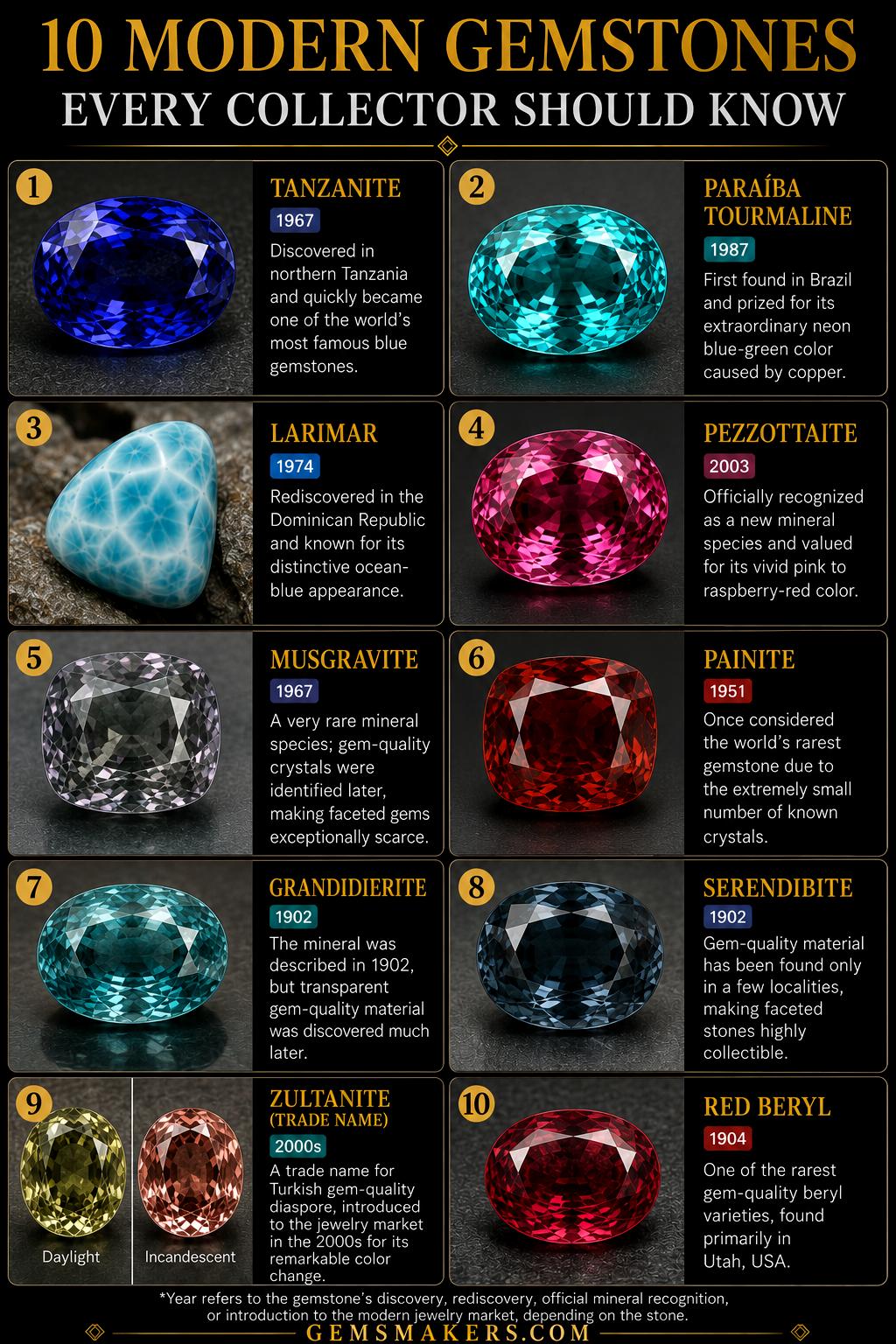
Today, gemstones such as tanzanite, Paraíba tourmaline, larimar, pezzottaite, musgravite, painite, grandidierite, serendibite, zultanite, and red beryl represent the modern era of gem discoveries. They remind us that Earth's geological history continues to surprise scientists, miners, and collectors with extraordinary natural treasures.
Quick Answer
Modern gemstones are gemstones that were discovered, officially recognized, or introduced into the jewelry market during the twentieth or twenty-first century. Many are exceptionally rare and have become highly collectible because of their limited sources, unique colors, or remarkable optical properties. Some of the best-known modern gemstones include tanzanite, Paraíba tourmaline, larimar, pezzottaite, musgravite, painite, grandidierite, serendibite, zultanite (gem-quality diaspore), and red beryl.
What makes a gemstone "modern"?
A modern gemstone does not necessarily mean the mineral itself formed recently. Nearly all gemstones formed millions or even billions of years ago inside the Earth.
Instead, "modern" usually refers to when the gemstone became known to science, when gem-quality material was first discovered, or when it entered the international jewelry market.
Some gemstones remained hidden because they occur in extremely remote locations. Others were overlooked because transparent crystals were incredibly rare. Advances in mineral exploration and gemology during the twentieth century allowed many previously unknown gems to reach collectors for the first time.
These discoveries expanded the gemstone world far beyond the traditional "Big Four" gemstones.
Tanzanite: the modern gemstone that became a global icon
Discovered in northern Tanzania in 1967, tanzanite is probably the most successful modern gemstone discovery.
Its rich blue to violet-blue color immediately attracted worldwide attention, and it quickly became one of the most recognizable gemstones in the jewelry industry. Unlike sapphire, tanzanite is found commercially in only one small mining area near the Merelani Hills, giving it exceptional geographic rarity.
Another reason collectors admire tanzanite is its strong pleochroism. Depending on the viewing angle, the gemstone may display blue, violet, or purplish tones.
Within only a few decades, tanzanite transformed northern Tanzania into one of the world's most important gemstone-producing regions and remains one of the greatest gemstone discoveries of the modern era.
Paraíba Tourmaline: the gemstone that changed colored gems forever
Few gemstone discoveries have had as much impact on the colored gemstone market as Paraíba tourmaline.
First discovered in Brazil in 1987, this remarkable gemstone stunned collectors with an electric neon blue-green color unlike anything previously seen. The extraordinary color is produced by traces of copper within the crystal.
Before Paraíba tourmaline appeared, most collectors believed no natural gemstone could display such vivid neon colors.
Demand increased almost immediately, making fine Paraíba tourmalines among the world's most valuable colored gemstones.
Today, the name Paraíba has become almost legendary among gemstone collectors because of its incredible color and rarity.
Larimar: the Caribbean gemstone
Larimar was rediscovered in the Dominican Republic in 1974 and rapidly became famous for its beautiful ocean-blue appearance.
Unlike transparent gemstones, larimar is appreciated for its soft blue color combined with white cloud-like patterns that resemble tropical seas.
Its appearance is unlike almost any other gemstone, making it easy to recognize.
Because commercial-quality larimar comes almost entirely from the Dominican Republic, it also has strong geographic identity, making it popular with collectors interested in locality gemstones.
Pezzottaite: one of the newest gemstone species
Pezzottaite is one of the newest gemstone minerals recognized by science.
Officially recognized in 2003, it immediately attracted attention because of its vivid pink to raspberry-red color.
Although it resembles some pink beryl varieties, pezzottaite is a completely separate mineral species with its own chemistry and crystal structure.
Fine faceted stones remain extremely rare, making pezzottaite highly desirable among advanced collectors who specialize in modern gemstone discoveries.
Musgravite: rarity at its finest
Musgravite is one of the rarest collector gemstones in existence.
Although the mineral was identified in 1967, gem-quality crystals were discovered much later, making faceted musgravite exceptionally scarce.
Most collectors may never see a fine musgravite in person.
Its rarity is one of its greatest attractions. Rather than being famous for dramatic optical effects, musgravite is admired because finding transparent gem-quality material is extraordinarily difficult.
Among serious collectors, musgravite is considered one of the ultimate rarity gemstones.
Painite: from unknown to legendary
Painite became famous because it was once regarded as the rarest gemstone in the world.
Discovered in Myanmar in 1951, only a handful of crystals were known for many years.
Although additional deposits have since been found, gem-quality painite remains exceptionally uncommon.
Its rich reddish-brown to deep red color combined with its remarkable rarity has earned it legendary status within the collector community.
Painite demonstrates that rarity alone can make a gemstone world-famous.
Grandidierite: a rare blue-green treasure
Grandidierite was first described in 1902, but transparent gem-quality crystals were discovered much later.
Its beautiful bluish-green color immediately attracted attention because few gemstones display exactly this combination of hues.
Fine grandidierite remains one of the rarest faceted gemstones available today.
Collectors appreciate both its rarity and its elegant appearance, making it one of the most respected modern collector gemstones.
Serendibite: one of the rarest faceted gemstones
Serendibite is another gemstone that few collectors will ever own.
Although first identified in 1902, transparent gem-quality material has only been found in a handful of localities worldwide.
Most serendibite occurs as opaque mineral specimens rather than transparent gems.
Because facetable crystals are exceptionally scarce, fine serendibite has become one of the most collectible gemstones in the modern market.
Zultanite: the remarkable color-change gemstone
Zultanite is the trade name for gem-quality Turkish diaspore introduced to the jewelry market during the 2000s.
Its greatest attraction is its natural color change.
Depending on the lighting, it may appear greenish, champagne, or pinkish.
Unlike many gemstones whose color remains constant, zultanite changes appearance throughout the day as lighting conditions change.
Its excellent transparency, durability, and attractive color shift have made it increasingly popular among collectors and jewelry enthusiasts.
Red Beryl: America's rare red gemstone
Red beryl is one of the rarest members of the beryl family.
Discovered in Utah during the early twentieth century, gem-quality material remains extremely scarce.
Unlike emerald or aquamarine, red beryl occurs in only a few small deposits, making high-quality stones exceptionally valuable.
Its vivid red color and limited production have earned it a reputation as one of the world's rarest colored gemstones.
For collectors specializing in American gemstones, red beryl is often considered an essential addition.
Why collectors love modern gemstones
Modern gemstones offer something different from traditional classics.
Many collectors already own sapphires, rubies, emeralds, or opals. Modern discoveries provide an opportunity to collect gemstones that are less familiar but often significantly rarer.
These stones also tell fascinating stories about scientific discovery, geology, and modern exploration.
Unlike gemstones known since ancient civilizations, many of these minerals entered the gem world only within the last century, making them part of a continuing story rather than ancient history.
Collectors appreciate that these gemstones represent some of the newest chapters in mineral discovery.
Modern discoveries continue to reshape gemology
The discovery of these gemstones demonstrates that gemology is still evolving.
New mineral species continue to be identified.
Previously overlooked deposits occasionally produce gem-quality material.
Improved mining methods sometimes reveal gemstones that were hidden for generations.
Although truly major discoveries are uncommon today, the possibility remains that another remarkable gemstone could one day join this list.
That continuing sense of discovery is one reason the gemstone world remains so exciting.
Final thoughts
Modern gemstone discoveries have expanded our understanding of what nature can create. Tanzanite introduced a spectacular new blue gemstone. Paraíba tourmaline revolutionized colored gemstones with its neon brilliance. Larimar brought the colors of the Caribbean into jewelry. Pezzottaite added an entirely new mineral species. Musgravite, painite, grandidierite, serendibite, zultanite, and red beryl all proved that some of the world's greatest treasures were still waiting to be discovered.
These gemstones remind us that the history of gemology is still being written. Every new discovery adds another chapter to our understanding of Earth's extraordinary mineral diversity, giving collectors fresh opportunities to own some of the rarest and most fascinating natural treasures ever found.
Looking for natural loose gemstones, collector stones, and jewelry-grade gems?
← Back