Top 10 Most Expensive Diamonds & Gemstones Ever Sold: The Legendary Stones
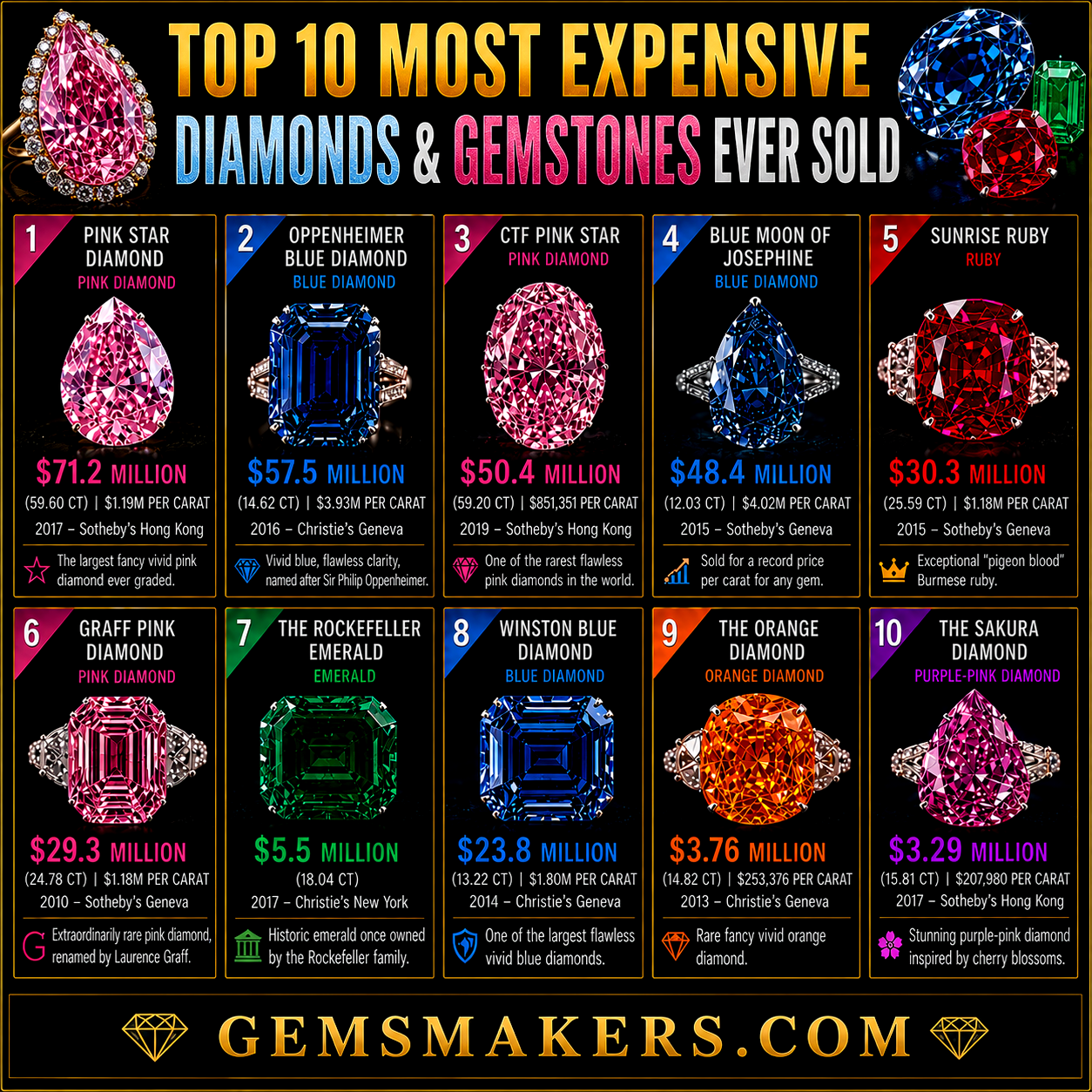
The story of ten of the most expensive diamonds and gemstones ever sold at auction, and it is a powerful reminder that not all beauty in the gem world is equal. Some stones are valuable because they are rare in color. Some are valuable because they are pure, flawless, and exceptionally large. Some become famous because of their history, their origin, their ownership, or the auction record they set. Some are diamonds. Some are rubies. One is an emerald. But every stone in this image belongs to a very elite world where rarity, beauty, size, and prestige come together at the highest possible level.
What makes this image especially interesting is that it is not just showing expensive jewelry. It is showing some of the most legendary natural gemstones ever handled by the auction world. These stones are not ordinary luxury gems. They are headline stones. They are record-breakers. They are the kind of gems that make collectors, jewelers, investors, and gem lovers stop and stare. The names alone carry enormous weight: Pink Star, Oppenheimer Blue, CTF Pink Star, Blue Moon of Josephine, Sunrise Ruby, Graff Pink, Rockefeller Emerald, Winston Blue, The Orange Diamond, and The Sakura Diamond. Each one has its own identity, its own color, and its own auction story.
A lot of people think a diamond is just a diamond, or that a ruby is just a ruby, but this image proves that the world of high-value gems is much deeper than that. A vivid pink diamond can be worth far more than a white diamond of much greater size because the color is rarer. A blue diamond can become an object of global fascination because the hue is so unusual and so highly prized. A ruby can set records because top-quality Burmese rubies with the right color are almost impossible to replace. An emerald with historic ownership can become a museum-level treasure. In the high-end gem world, it is never just about sparkle. It is about rarity, color saturation, clarity, origin, size, and story.
That is why this graphic works so well. It does not just show expensive stones. It shows the hierarchy of desire in the gemstone market. The stones at the top are not necessarily the biggest in size, but they are among the most extraordinary in color, purity, and collector demand. The image is basically a snapshot of the gemstone world at its most elite. It shows the exact types of stones that command the highest prices because they combine natural rarity with human obsession.
Let us go through each one carefully, because each gem deserves its own space.
1. Pink Star Diamond
The Pink Star Diamond is one of the most famous and valuable pink diamonds ever sold. In the image, it appears at number one with a sale price of $71.2 million, weighing 59.60 carats, and sold in 2017 at Sotheby’s Hong Kong. That alone tells you a lot about its importance. A pink diamond of that size and quality is already rare. A pink diamond of that size, with exceptional vivid color and extraordinary clarity, becomes a global sensation.
Pink diamonds sit in a category of their own because natural pink color is one of the rarest and most desirable colors in the diamond world. Their value comes from the fact that the color is not created by impurities in the same way as blue or yellow diamonds. Instead, the pink coloration is linked to structural distortion in the crystal lattice, which makes the color both scientifically fascinating and visually beautiful. That combination is exactly why pink diamonds are so prized.
The Pink Star Diamond is especially legendary because it is not only beautiful but also enormous for a pink diamond of fine quality. The size gives it power, but the color gives it identity. A smaller pink diamond can be valuable, but a nearly 60-carat vivid pink diamond enters an entirely different category. It becomes a record-breaking gem that people talk about for years.
One of the reasons the Pink Star commanded such a staggering price is the balance between size and color intensity. It is not enough for a pink diamond to be large. It must also show the right saturation, the right tone, the right clarity, and the right overall visual impact. The Pink Star had all of those. It was one of those rare stones that immediately became iconic because the gem world knew exactly what it was looking at: a once-in-a-generation fancy vivid pink diamond.
Pink diamonds are often associated with romance, rarity, and prestige, and the Pink Star became a symbol of everything that makes colored diamonds so irresistible to wealthy collectors. It is the kind of gem that shows how color can push a diamond far beyond ordinary value.
2. Oppenheimer Blue Diamond
At number two in the image is the Oppenheimer Blue Diamond, sold for $57.5 million in 2016 at Christie’s Geneva. It weighs 14.62 carats, which is far smaller than the Pink Star, yet its price is still astronomical. That is the magic of elite colored diamonds. The value is not just about size. It is about rarity, color purity, and the reputation of the stone itself.
The Oppenheimer Blue is one of the finest vivid blue diamonds ever sold. Blue diamonds are among the rarest diamonds on Earth because their color comes from the presence of trace amounts of boron. But not just any blue diamond becomes famous. The top tier is reserved for stones with extremely pure color, excellent clarity, and top-quality cut. The Oppenheimer Blue had all of that and more.
Blue diamonds have a very different personality from pink diamonds. Pink diamonds feel romantic and brilliant. Blue diamonds feel cold, royal, mysterious, and almost electric. Their color gives them a dramatic presence that is instantly memorable. The best blue diamonds do not just appear blue; they appear to carry light inside them. They often look deep, saturated, and mesmerizing, especially under jewelry lighting.
The Oppenheimer Blue became legendary not just because of its color but because it was once part of a famous private collection. That kind of provenance helps elevate a diamond’s status. When a stone carries a name, a history, and a reputation, it becomes more than a gem. It becomes a milestone in gem history.
The Oppenheimer Blue is also important because it holds the record as one of the most expensive blue diamonds ever sold. That tells you how powerful the market for top-color fancy diamonds can be. When collectors chase the best of the best, the price can move into a completely different world. A 14.62-carat stone selling for more than fifty-seven million dollars is a perfect example of how the high-end gem market values perfection, rarity, and exclusivity.
3. CTF Pink Star Pink Diamond
The CTF Pink Star appears at number three in the image, sold for $50.4 million in 2019 at Sotheby’s Hong Kong. It weighs 59.20 carats, which is almost the same size range as the Pink Star, and that similarity is important because it helps show why this family of large fancy vivid pink diamonds is so iconic. The CTF Pink Star is one of the largest and most famous internally flawless pink diamonds in the world.
This stone is especially significant because it combines enormous size with extraordinary quality. In the diamond world, size alone is not enough. Large stones are common compared to large stones with exceptional color and clarity. The CTF Pink Star represents the rare overlap where size, color, and condition all come together at a very high level.
Pink diamonds are so rare that a large vivid pink stone instantly becomes a major event in the auction world. The CTF Pink Star belongs to that small circle of legendary stones that define the category. Its value comes from the same force that drives all top fancy colored diamonds: the extraordinary scarcity of color at the very highest level of quality.
The visual identity of the CTF Pink Star is beautiful because it has a rich pink saturation that looks both powerful and refined. It is the kind of stone that represents the apex of pink diamond collecting. For many gem lovers, a vivid pink diamond of this caliber is one of the most desirable stones on Earth.
The name itself carries prestige because it signals a connection to luxury, rarity, and high-stakes auction history. These are the kinds of stones that do not simply sell; they make headlines, define market records, and reshape expectations about what colored diamonds can be worth.
4. Blue Moon of Josephine
At number four is the Blue Moon of Josephine, sold for $48.4 million in 2015 at Sotheby’s Geneva. It weighs 12.03 carats, making it much smaller than the large pink diamonds in the image, but the price is still extraordinary. That tells you just how powerful fancy vivid blue diamonds can be when they have top-tier color and clarity.
The Blue Moon of Josephine is one of the most famous blue diamonds ever sold. Its name alone sounds elegant and poetic, which suits the stone’s appearance. Blue diamonds are associated with mystery, depth, and rarity, and this stone has all of that. The color is rich, intense, and highly desirable, giving the diamond a striking presence despite its comparatively modest size.
A blue diamond of this quality is incredibly rare. The combination of a vivid hue, clean appearance, and dramatic emotional effect makes it one of the most sought-after categories in the diamond world. The Blue Moon of Josephine is often celebrated because it shows how a small diamond can still command a massive price when the color and quality are exceptional.
The gemstone’s value is also tied to the fact that blue diamonds are highly collectible and globally admired. Buyers at this level are not simply shopping for jewelry. They are competing for one-of-a-kind assets, historical gems, and pieces that feel almost impossible to replace. A diamond like this becomes a trophy stone.
The Blue Moon of Josephine is also visually unforgettable because blue diamonds have a certain cool intensity that separates them from every other color family. They do not look soft or pastel. They look rich and commanding. That visual force is what makes them so desirable in elite gemstone auctions.
5. Sunrise Ruby
The Sunrise Ruby sits at number five in the image and is one of the most valuable rubies ever sold. It brought in $30.3 million in 2015 at Sotheby’s Geneva, weighed 25.59 carats, and achieved one of the highest prices per carat ever seen for a ruby. The image also highlights its “pigeon blood” Burmese ruby status, which is one of the most important clues to why it is so valuable.
A top Burmese ruby with intense red color is one of the rarest and most prized gemstones in the world. The finest rubies are sought after not just for their color, but for the way the color feels alive. The richest rubies have a deep red glow with a hint of internal fire, which gives them enormous visual power. The Sunrise Ruby is exactly the kind of stone that defines the category.
Rubies from Burma, especially from the legendary Mogok region, are especially famous because they often show the strong red color and fluorescence that collectors value so highly. The most desirable rubies are often described as pigeon blood red, meaning an intense, pure red with slight cool undertones and exceptional vibrancy. When that color appears in a fine, clean, large ruby, the result can reach astonishing prices.
The Sunrise Ruby is important because it demonstrates how a ruby can rival or even exceed diamonds in auction value when the color and origin are exceptional. It is a reminder that gemstones are not ranked by hardness alone, or by tradition alone. Color rarity and visual excellence matter enormously.
Its value also reflects the emotional power of red. Red is a color associated with passion, royalty, power, and intensity. A top ruby captures all of that in a single stone. The Sunrise Ruby is not just a gemstone. It is one of the most famous red treasures ever sold.
6. Graff Pink Diamond
The Graff Pink Diamond appears at number six in the image, sold for $29.3 million in 2010 at Sotheby’s Geneva. It weighs 24.78 carats and remains one of the most famous pink diamonds in the world. The name itself is especially important because Laurence Graff, the famous jeweler and collector, acquired and renamed it, which helped cement its fame.
The Graff Pink is valued for its extraordinary color and historical significance. Pink diamonds of this quality are incredibly rare, and a stone of nearly 25 carats with excellent saturation is a major collector gem. Its reputation increased even more because of the man who owned it and the way it was presented to the world.
Color is the key. The best pink diamonds are not merely faintly pink. They must have strong enough color to be visually compelling while still retaining the brilliance that makes diamonds so desirable. The Graff Pink fits that standard beautifully. It is one of the most important examples of a premium vivid pink diamond sold at auction.
The stone is also notable because it reminds people that famous jewelers can shape gemstone history by selecting, preserving, and presenting exceptional stones. The Graff Pink is not just a jewel. It is a chapter in the history of high jewelry. Its value is partly intrinsic and partly cultural. A famous diamond with a famous owner becomes even more iconic.
For many collectors, the Graff Pink represents the dream of owning a large, intense, beautifully cut pink diamond. It sits in the highest tier of colored diamond desirability.
7. The Rockefeller Emerald
The Rockefeller Emerald appears at number seven and is the most famous emerald in the image. It sold for $5.5 million in 2017 at Christie’s New York and weighs 18.04 carats. Although its auction price is far below the giant pink and blue diamonds above it, the Rockefeller Emerald is still one of the most historically significant gemstone sales ever recorded.
Emeralds are loved for their green color, but fine emeralds are notoriously difficult to find because the gemstone often contains inclusions and internal features that are accepted as part of the stone’s character. That makes large, fine, well-cut emeralds especially valuable. The Rockefeller Emerald is famous not just because it is beautiful, but because it carries historical prestige. It once belonged to the Rockefeller family, which adds another layer of interest.
A historic emerald with strong color and elite provenance becomes more than just a gemstone. It becomes a museum piece, a family legacy, and a collector trophy all in one. The Rockefeller name already carries enormous cultural weight, and when it is tied to a superb emerald, the result is a gemstone that stands out even in a field filled with records.
The deep green of emerald has a special power because green is associated with life, wealth, nature, and growth. Emeralds have long been treasured by royalty and collectors for that reason. The Rockefeller Emerald fits the image of a classic heirloom gemstone that combines natural beauty with a strong ownership history.
While emeralds may not always sell for the same astronomical figures as some fancy colored diamonds, the finest examples still command major respect and strong auction prices. This emerald is a perfect reminder that gemstone value is about more than size. History, origin, and prestige all matter.
8. Winston Blue Diamond
At number eight is the Winston Blue Diamond, sold for $23.8 million in 2014 at Christie’s Geneva. It weighs 13.22 carats and is one of the most famous blue diamonds ever sold. Like the Blue Moon of Josephine, it belongs to the elite category of vivid blue diamonds, but it has its own identity and reputation.
Blue diamonds are rare because of boron, and among blue diamonds, the top examples are extraordinarily uncommon. A 13.22-carat vivid blue diamond with strong clarity and perfect prestige is a very serious stone. The Winston Blue is one of those gems that demonstrate how powerful the fancy color diamond market really is.
The name Winston also adds stature because it links the diamond to a world-famous luxury jewelry brand. Brand association matters in the high-end gem world. A named diamond with a recognizable identity immediately gains more public attention, stronger provenance, and more collector appeal.
The Winston Blue is visually striking because blue diamonds often have a calm but intense look. They can seem deep, liquid, and almost mysterious. That mysterious quality is part of what makes them so desirable. They do not shout the way some colored stones do. They draw you in.
The auction result for the Winston Blue shows how much buyers are willing to pay for an exceptional blue diamond when quality and reputation align. It is one of the important stones in the blue diamond story and deservedly sits on a list of all-time expensive gems.
9. The Orange Diamond
The Orange Diamond appears at number nine in the image, sold for $3.76 million in 2013 at Christie’s Geneva. It weighs 14.82 carats and is one of the rarest and most visually striking fancy colored diamonds on the list because true orange diamonds are extremely uncommon.
Orange diamonds occupy a special place in gem collecting because the color is unusual and powerful. A pure fancy vivid orange diamond can be difficult to find, and when a strong stone appears, it immediately attracts attention. The color is warm, vibrant, and energetic, sitting somewhere between the fire of red and the brilliance of yellow.
The Orange Diamond is valuable because orange diamonds in this quality range are rare and beautiful. A rich orange hue in a diamond can look like a captured flame or glowing ember. That makes the gemstone feel lively and visually dynamic.
Unlike some of the higher-ranked stones in the image, this one is smaller in auction value, but it is no less interesting. It represents the rare color spectrum of natural diamonds and shows that even stones outside the most famous pink and blue categories can achieve major value when the color is exceptional.
The Orange Diamond is one of the best examples of how vivid color can transform a diamond into a collectible treasure. It is bold, energetic, and highly distinctive.
10. The Sakura Diamond
The Sakura Diamond appears at number ten in the image and is described as a purple-pink diamond. It sold for $3.29 million in 2017 at Sotheby’s Hong Kong, weighed 15.81 carats, and was inspired by cherry blossoms. That poetic association fits beautifully because purple-pink diamonds often carry a soft, romantic, and highly desirable appeal.
The Sakura Diamond is especially charming because it represents the gentler, more delicate side of fancy colored diamonds. Purple-pink tones can be highly attractive because they combine the warmth of pink with the subtle complexity of purple. That blend creates a gemstone that feels elegant and unusual without being overly aggressive in color.
The cherry blossom inspiration is appropriate because the stone likely evokes the soft beauty and fleeting elegance associated with sakura flowers. That kind of emotional association can increase the desirability of a gemstone in the eyes of collectors and luxury buyers. People are not only buying color; they are buying a feeling, a mood, a visual story.
The value of the Sakura Diamond is also a reminder that not every expensive gemstone needs to break the fifty-million-dollar mark to be significant. A highly attractive, rare, well-colored diamond in a desirable shade can still bring in a multi-million-dollar result. That is a strong result in the auction world and confirms that colored diamonds of unusual hues remain in very high demand.
Purple-pink diamonds are not as common in public discussion as pink or blue diamonds, which gives them an additional layer of intrigue. The Sakura Diamond stands out because it feels graceful, refined, and visually poetic.
Why These Stones Are So Expensive
The stones in this image are expensive for a combination of reasons, and those reasons repeat across the entire luxury gemstone market. Rarity is the first and most obvious factor. Fancy vivid pink diamonds are rare. Fancy vivid blue diamonds are rare. Large top-color rubies are rare. Historic emeralds with strong provenance are rare. Exceptional orange and purple-pink diamonds are rare. When rarity combines with size, clarity, and beauty, value rises quickly.
The second factor is color. In the colored gemstone world, color is often the deciding factor. The best-colored stones are vastly more valuable than stones with weaker or less desirable hues. In the image, every stone has a color story that makes it stand out from ordinary gems. The pinks are vivid. The blues are rich. The ruby is intensely red. The emerald is historically important and beautifully green. The orange and purple-pink diamonds are unusual and eye-catching. Color is the soul of their value.
The third factor is size. A small intense gem can be valuable, but a large intense gem in the same quality range becomes far more significant. Size is a force multiplier when combined with color rarity. That is why the Pink Star, CTF Pink Star, Graff Pink, and other large stones command such strong prices.
The fourth factor is clarity and quality. At the high end, a gemstone needs to have excellent transparency, strong luster, and minimal visible flaws or structural problems. The higher the quality, the more a buyer is willing to pay.
The fifth factor is provenance and fame. A famous stone becomes even more desirable because the story adds identity. The Oppenheimer Blue, Blue Moon of Josephine, Rockefeller Emerald, and Graff Pink all have names that elevate them beyond the category of ordinary stones. Famous ownership, auction history, and naming conventions all add cultural weight.
Why Auction Houses Matter So Much
Auction houses like Sotheby’s and Christie’s are essential in this world because they provide the stage where world-record stones are sold publicly. These institutions bring trust, publicity, exclusivity, and competition together in one place. When a stone appears in a top auction, it instantly enters the global conversation. Collectors, investors, museums, and luxury buyers all pay attention.
A private sale may be high value, but an auction result becomes part of gemstone history. That is why the dates and venues in the image matter. They are not just sales details. They are part of the record. They help define the importance of each stone in the public imagination.
What These Gemstones Teach Us
This image teaches an important lesson about value in the gem world: beauty is not simple. A gemstone becomes expensive when many different things align at once. Color, size, rarity, origin, clarity, history, and demand all have to come together. A gem that looks beautiful to the eye may still not be valuable if it is common. A gem that is deeply rare may reach extraordinary prices even if it is smaller than others. This is why the top-tier gemstone market is so fascinating. It rewards not just appearance, but story and scarcity.
It also teaches that diamonds are not the only stars of the luxury gem world. Rubies, emeralds, and other colored stones can compete at the highest level when their quality is exceptional. In some cases, colored gemstones even outperform diamonds in price per carat because their rarity is extreme. The Sunrise Ruby is one of the best examples of this.
The image also reminds us that colored diamonds occupy a very special place in gemstone collecting. Pink, blue, orange, and purple-pink diamonds are all incredibly rare. That rarity makes them the most exciting stones for many high-end collectors. They are not just luxurious. They are geological miracles.
Final Thoughts
The stones in this image represent the top tier of the gemstone world. They are not just expensive because they are pretty. They are expensive because they are rare, historically important, visually unforgettable, and fiercely desired by elite collectors. The Pink Star Diamond, Oppenheimer Blue Diamond, CTF Pink Star, Blue Moon of Josephine, Sunrise Ruby, Graff Pink Diamond, Rockefeller Emerald, Winston Blue Diamond, The Orange Diamond, and The Sakura Diamond each represent a different branch of gemstone greatness.
Together, they show the full spectrum of what makes a stone valuable. Some are prized for color. Some for size. Some for origin. Some for history. Some for emotional appeal. Some for all of those things at once. That is why they remain some of the most famous gems ever sold.
If you are building content around expensive gemstones, colored diamonds, collector gems, auction stones, or the most valuable diamonds ever sold, this image gives you a powerful starting point. It is a perfect example of why the world of gems is so addictive: every stone has a story, and the best stories are written in color, clarity, and rarity.
Looking for rare natural gemstones, collector diamonds, and unique luxury stones? Visit Our Shop
← Back